What would happen if we detonated humanity's most powerful nuclear weapon at the deepest point of the ocean? Tsunamis hundreds of meters high would destroy coastal cities? Earthquakes would level countries? New volcanoes would bring us nuclear winter? Or even earth could be ripped apart or thrown out of orbit?
The deepest place
Currently, Earth's deepest known point is inside the Mariana Trench. The Mariana Trench is a very deep valley right at the edge of two tectonic plates that looks like an upside-down mountain. It reaches a depth of about 11 kilometers, almost three times deeper than the dark grave of the Titanic. It's one of the last places on Earth for humans to explore, pitch-black, and under a thousand atmospheres of pressure. It's a relatively pristine environment thanks to the absence of humans. It appears to be the great place for our nuclear test.
Tsar Bomba
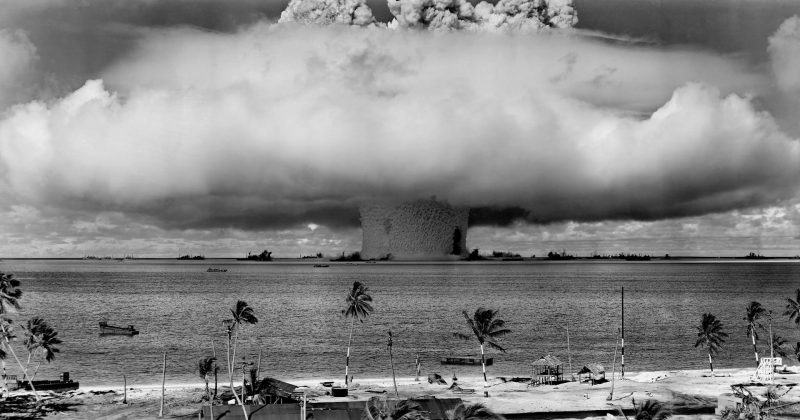
Let's use the most powerful nuclear bomb humans have ever exploded - Tsar Bomba. Its explosion was so massive that its shock wave traveled around the Earth three times, and its mushroom cloud stretched 56 kilometers into the sky. Its shock wave was strong enough to destroy everything in a thousand square kilometers. Bombs like this release such an enormous amount of energy at once that they could boil away an entire lake. And if we set off a nuclear bomb in the Mariana Trench, that's exactly what we expect to see.
Tsar Bomba is the most powerful nuclear weapon ever detonated, yield of 50 megatonnes (50 million tonnes of TNT). In its "final" form (i.e. with a depleted uranium tamper instead of one made of lead) it would have been 100 megatonnes.
Let's pull the trigger
In the first few microseconds, the nuclear fuel undergoes its chain reaction and explodes with the power of 50 megatons of TNT. A blinding flash of light illuminates the darkness of the trench for the first time in history. The heat of the explosion produces a cavity, a flaming bubble of water vapor, radioactive nuclei, and the remains of very unlucky fish.
The bubble grows quickly as it vaporizes the water around it. The pressure of the bubble is immense, plowing outward as if there's nothing in the way, sending off a shock wave that will be felt by seismic stations and whales around the world. And then, almost as fast as it emerges, it stops.
On the surface of the Earth, this fireball bubble would grow to 10 kilometers the second after it's detonated, as the atmosphere barely puts up a fight to hold it back. But the pressure at the bottom of the Mariana Trench is enormous, with 11 kilometers of water overhead. Being in the Mariana Trench is like being crushed by a hydraulic press from every direction.
 Image Credit: TimeBoil
Here, a second after the detonation, the bubble is about a kilometer across when, oddly enough, it starts to shrink. The bubble overextends itself, losing pressure as it expands until the water turns it back, recompressing it. The tug of war between the fiery death bubble and water goes back and forth a few times, the bubble shrinking and growing until eventually, the bubble loses for good. The pressure around it is too great, and turbulent water begins to chop it up. It becomes something like the underwater equivalent of a mushroom cloud as it disintegrates into many smaller, hot, and radioactive bubbles drifting upwards.
As the mighty destructive blast rises to the surface, it does basically nothing, just a small wave and a bubbling plume of radioactive warm water in the Pacific. No tsunami will wash away Japan or California, although boats and whales in the area might have a bad time. The radioactive fallout will be diluted into the Pacific after a few days, although a fair amount of radioactive water and salt makes it to the atmosphere where it collects and then rains down again. Even if the wind blows the fallout directly towards the Philippines, the worst of it probably happens over the oceans.
But the real danger does come from the explosion triggering earthquakes and volcanoes, right? Even if we detonated the bomb right in the trench at the exact point where tectonic plates touch, probably not. The explosion would vaporize a part of the seafloor and turn a lot of sand into glass, but most of the energy goes into the water, not seismic waves. Earthquakes are already quite common at tectonic plate boundaries, and earthquakes with as much seismic energy as the bomb happen a few times a year without triggering any sort of apocalypse.
But maybe it will affect the Earth's orbit, is that true? Since no mass is taken away or added to the Earth, the orbit is completely unaffected. Also, there have been well over a thousand nuclear tests in the last 70 years, which didn't change the orbit, so why would this time be different?
So what happens to us if we detonate a nuclear weapon really deep in the ocean? Pretty much nothing. The planet is too big, it doesn't care.
What Would Happen If a Nuclear Bomb Was Detonated in the Mariana Trench?
Tags
Prochlorococcus, the most abundant microbe in the oceans, is facing a survival crisis due to global warming. This single-celled cyanobacterium, found across more than 75% of the ocean's surface waters,…
A recent study published in Science Advances highlights a striking gap in our understanding of the deep ocean, which covers 66% of Earth's surface. According to the findings, less than…
Carbon dioxide (CO₂) emissions from human activities are not only altering the Earth’s atmosphere but are also rapidly acidifying the oceans. A new study published this week in the Proceedings…
A new study published in Nature Communications suggests that rising temperatures in polar regions could significantly disrupt ocean circulation patterns. The lead author of this study underscores that our findings indicate…
Enduring for 250 Million Years: The Ancient Presence of the Weather-Influencing El Niño Oscillation
The El Niño phenomenon, a massive warm oceanic mass in the tropical Pacific Ocean, has the capacity to alter global rainfall patterns and is not a modern occurrence. A recent modeling…
Physicists have now demonstrated all the crucial components that make up a nuclear clock—a device that tells time by measuring tiny energy changes within atomic nuclei. Such a clock could…