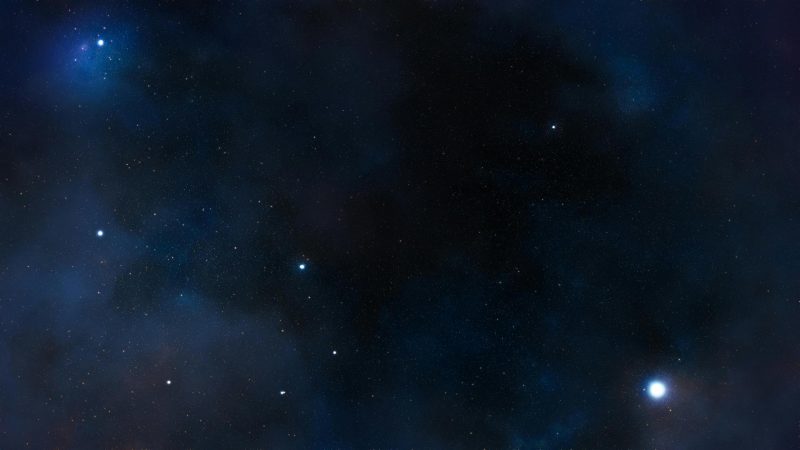
Black holes are the most interesting but mysterious objects in the universe. A black hole is a region in space where the gravitational force is so intense that nothing, not even light, can escape. The boundary of a black hole is known as the event horizon, which marks the point of no return beyond which we cannot observe anything. When an object crosses the event horizon, it falls into the black hole's singularity, an infinitely dense and small point where the laws of physics, space, and time breakdown.
Scientists have proposed several types of black holes, but the most common ones are stellar and supermassive black holes. Stellar black holes form when massive stars die and collapse. They are usually 10 to 20 times more massive than our sun and can be found throughout the universe. The Milky Way galaxy alone may contain millions of these black holes. On the other hand, supermassive black holes are much larger, measuring millions or even billions of times more massive than our sun. Scientists still don't fully understand how they form, but they know that they exist at the center of almost all large galaxies, including our own.
Sagittarius A, the supermassive black hole at the center of the Milky Way, has a mass of about four million suns and a diameter as large as the distance between the earth and our sun.

Because black holes are invisible, scientists can only detect and study them by observing their effects on their neighbors, including accretion disks, which form when gases and dust fall towards a black hole, and quasars, which are jets of particles that blast out of supermassive black holes.
Black holes were mostly unknown until the 20th century when a German physicist Karl Schwarzschild used Einstein's general theory of relativity to calculate that any mass could become a black hole if compressed tightly enough. But it was not until 1971 that astronomers discovered the first black hole while studying the constellation Cygnus.
Black holes warp space and time, always inspiring scientists and our collective imagination endlessly. The study on black wholes continues to be one of the most exciting and challenging fields in astrophysics.
Tags
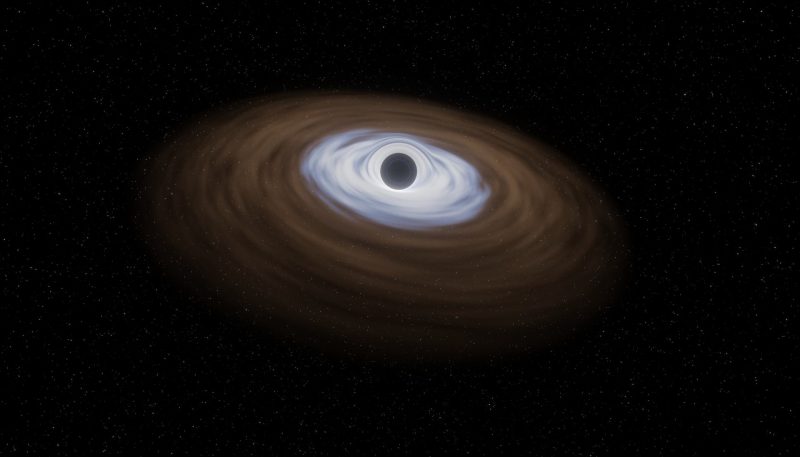
ng data from the MaNGA survey at the Apache Point Observatory, researchers detected this black hole in a dwarf galaxy about 230 million light-years away. Unlike typical supermassive black holes…
LIGO Detects Record-Breaking Black Hole Merger, Confirming Einstein and Hawking Predictions
Astronomers have detected the strongest gravitational wave signal ever recorded, produced by the collision of two black holes, using the U.S.-based Laser Interferometer Gravitational-Wave Observatory (LIGO). The breakthrough provides the…
A new study suggests that supermassive black holes could function as natural particle colliders, potentially offering a novel path to detect dark matter and other unknown particles. This discovery may…
Since its 2022 launch, NASA's James Webb Space Telescope (JWST) has detected hundreds of mysterious “little red dots” in the early universe—objects appearing within the first billion years after the…
Supermassive Black Hole in Nearby Galaxy Launches High-Speed Jets into Intergalactic Space
The European Southern Observatory (ESO) has announced a significant discovery: a supermassive black hole at the center of the spiral galaxy NGC 4945 is not only actively consuming matter but…
Recent astronomical observations suggest that dark energy—the mysterious force driving the accelerated expansion of the universe—may not be constant, a revelation that could reshape the foundations of modern physics. An international…