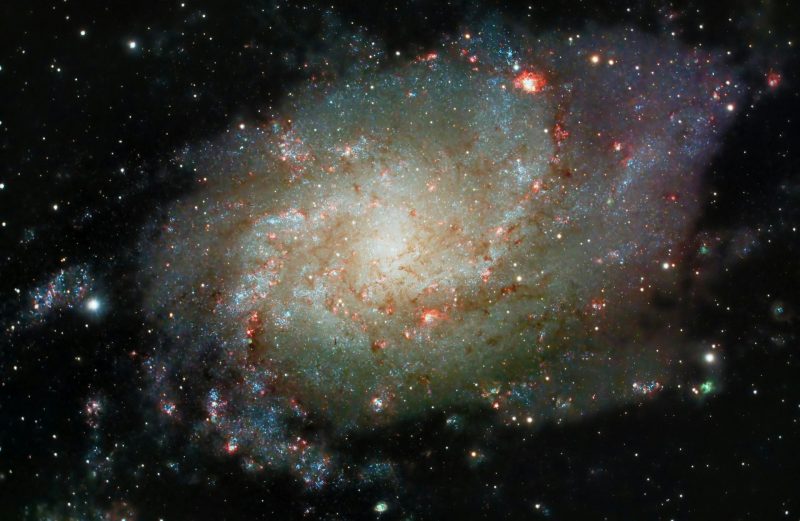
Recent astronomical observations suggest that dark energy—the mysterious force driving the accelerated expansion of the universe—may not be constant, a revelation that could reshape the foundations of modern physics.
An international research team conducted a three-year observational study using the Dark Energy Spectroscopic Instrument (DESI), analyzing data from 15 million galaxies. Their findings indicate that dark energy, long assumed to be unchanging, may be gradually weakening. This challenges the prevailing "cosmological constant" theory, which posits that dark energy is a fixed force sustaining the universe's expansion.
By integrating data from multiple observational sources—including cosmic microwave background radiation, supernova explosions, and gravitational lensing—the researchers found statistical evidence for dark energy variation at a significance level between 2.8 and 4.2 sigma. Although it falls short of the 5-sigma threshold required for definitive confirmation in physics, a 4.2-sigma significance level is already approaching a groundbreaking discovery.
If confirmed, this finding would necessitate a fundamental revision of cosmological theories explaining the universe's evolution. As one of the most advanced astronomical survey projects, DESI can simultaneously capture the spectral data of 5,000 galaxies and ultimately aims to observe 50 million celestial objects.
Dark Energy May Be Weakening, Challenging Core Physics Theories
Tags
Scientists have captured the most detailed image yet of the universe just 380,000 years after the Big Bang, using the Atacama Cosmology Telescope (ACT). This groundbreaking observation reveals the motion…
Countless stars pepper the universe, yet why does space appear so dark? This question has plagued humanity for centuries and is known in astronomy as "Olbers' Paradox". An associate professor of…
An international research team has utilized cosmic-scale observational data to verify the gravitational predictions of Einstein's general theory of relativity. Scientists employed the Dark Energy Spectroscopic Instrument (DESI) in the creation…
In the dark expanse of the sky, Omega Centauri, a visibly striking cluster in the Milky Way, stands out as one of the brightest star clusters, harboring millions of ancient…
n a groundbreaking revelation, NASA has unveiled a comprehensive catalog showcasing 126 recently discovered planets orbiting distant stars. This catalog, a collaborative effort by a global team of scientists in…