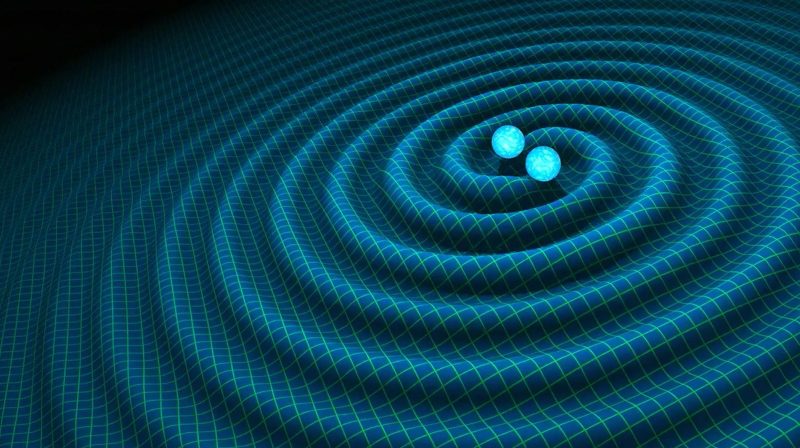
Astronomers have detected the strongest gravitational wave signal ever recorded, produced by the collision of two black holes, using the U.S.-based Laser Interferometer Gravitational-Wave Observatory (LIGO). The breakthrough provides the most robust observational evidence to date for Einstein's general relativity and Stephen Hawking's black hole area theorem.
The event occurred in the distant universe, where black holes with masses 33.6 and 32.2 times that of the Sun spiraled together. In January 2025, LIGO's detectors in Louisiana and Washington simultaneously captured the exceptionally high signal-to-noise data, enabled by a threefold increase in sensitivity in recent years.
The newly formed black hole underwent a brief "ringdown" at a frequency of 247 cycles per second, lasting about 10 milliseconds. By analyzing both the fundamental tone and overtones of this ringing, researchers confirmed the prediction that a black hole is defined solely by its mass and spin, and found the frequencies and decay rates matched theoretical expectations.
Analysis further revealed that the merged black hole's event horizon expanded to roughly 400,000 square kilometers. Despite the system losing mass through gravitational wave radiation, the total horizon area still exceeded the combined areas of the original black holes, directly validating Hawking's theorem that black hole surface area never decreases.
While researchers minimized theoretical assumptions in their analysis, they note that additional model-independent tests are needed. With further improvements in LIGO's sensitivity, scientists expect to detect more oscillation modes, enabling even more precise tests of general relativity and probing its limits.
LIGO Detects Record-Breaking Black Hole Merger, Confirming Einstein and Hawking Predictions
Tags
ng data from the MaNGA survey at the Apache Point Observatory, researchers detected this black hole in a dwarf galaxy about 230 million light-years away. Unlike typical supermassive black holes…
A new study suggests that supermassive black holes could function as natural particle colliders, potentially offering a novel path to detect dark matter and other unknown particles. This discovery may…
Since its 2022 launch, NASA's James Webb Space Telescope (JWST) has detected hundreds of mysterious “little red dots” in the early universe—objects appearing within the first billion years after the…
Supermassive Black Hole in Nearby Galaxy Launches High-Speed Jets into Intergalactic Space
The European Southern Observatory (ESO) has announced a significant discovery: a supermassive black hole at the center of the spiral galaxy NGC 4945 is not only actively consuming matter but…
A research team from the University of California, Riverside, has published a groundbreaking study in Physical Review Letters, demonstrating a major advancement in optical technology that could substantially improve the…