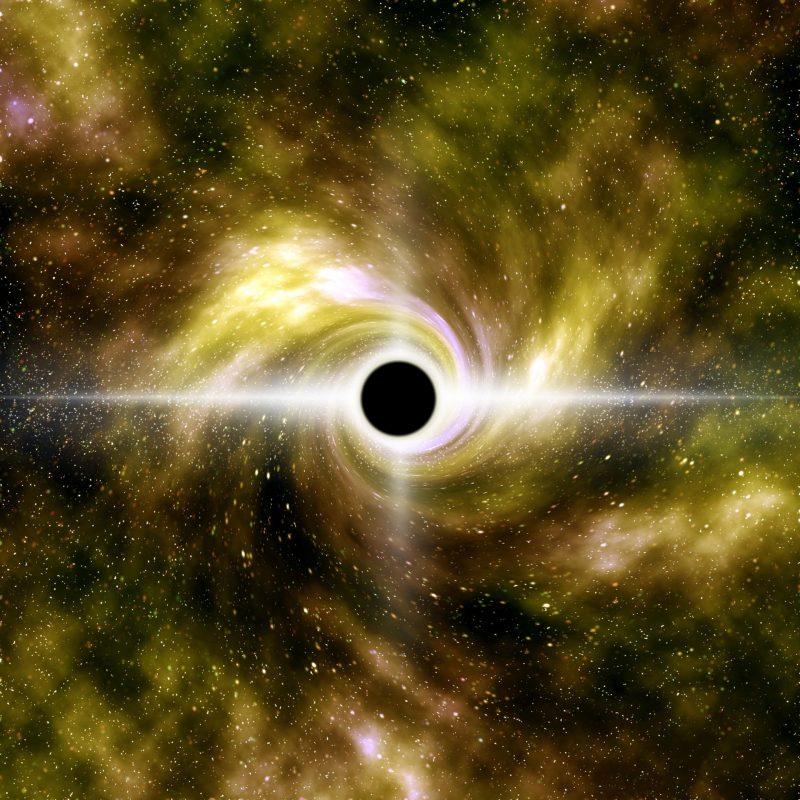
A new study suggests that supermassive black holes could function as natural particle colliders, potentially offering a novel path to detect dark matter and other unknown particles. This discovery may help overcome the immense cost and long timelines associated with constructing human-made accelerators.
Currently, the Large Hadron Collider (LHC) in Europe is the world’s most powerful particle accelerator, but it has yet to observe dark matter particles. Plans are underway for an even larger next-generation collider, projected to cost around $30 billion and take 40 years to build. In contrast, black holes—extreme cosmic objects—may generate particle collisions with far greater efficiency, possibly even producing detectable dark matter signals.
The rapid rotation and intense gravitational fields of black holes can accelerate nearby particles, triggering high-energy collisions. Some of the resulting particles could escape and reach Earth with extraordinary energies, in a process comparable to collider experiments but on a vastly greater scale.
Scientists may be able to capture these particles using existing facilities such as the IceCube Neutrino Observatory in Antarctica or the KM3NeT neutrino telescope in the Mediterranean Sea, both already designed to detect extreme cosmic events.
According to researchers from Johns Hopkins University, despite their great distance, black holes may still produce high-energy particles detectable on Earth. This finding could open new avenues for dark matter research while reducing reliance on costly artificial accelerators. The study was recently published in Physical Review Letters (PRL).
Supermassive Black Holes May Act as Natural Particle Colliders
Tags
A mysterious gamma-ray glow at the center of the Milky Way — puzzling scientists for decades—may finally offer the first observational evidence of dark matter. The finding, based on a…
ng data from the MaNGA survey at the Apache Point Observatory, researchers detected this black hole in a dwarf galaxy about 230 million light-years away. Unlike typical supermassive black holes…
LIGO Detects Record-Breaking Black Hole Merger, Confirming Einstein and Hawking Predictions
Astronomers have detected the strongest gravitational wave signal ever recorded, produced by the collision of two black holes, using the U.S.-based Laser Interferometer Gravitational-Wave Observatory (LIGO). The breakthrough provides the…
Since its 2022 launch, NASA's James Webb Space Telescope (JWST) has detected hundreds of mysterious “little red dots” in the early universe—objects appearing within the first billion years after the…
Subatomic particles such as quarks can be linked by "strings" of force fields that release energy when stretched to the point of breaking. Recently, two international research teams successfully simulated…