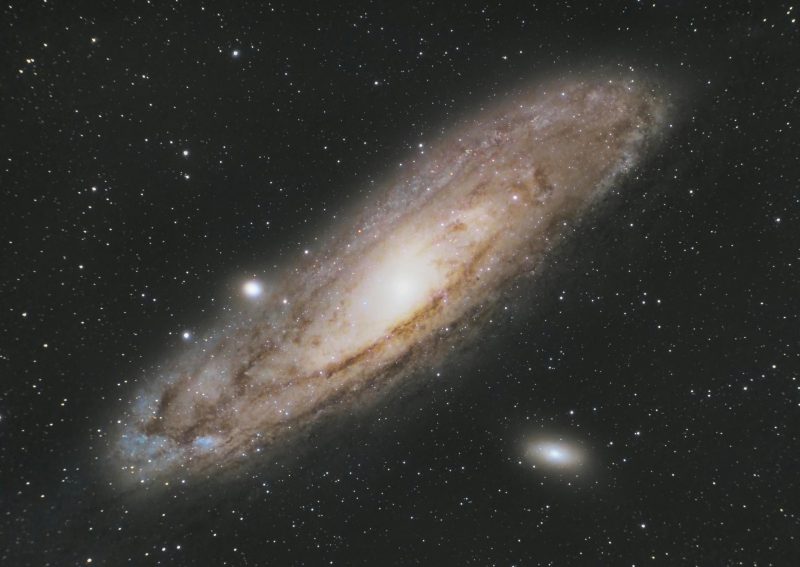
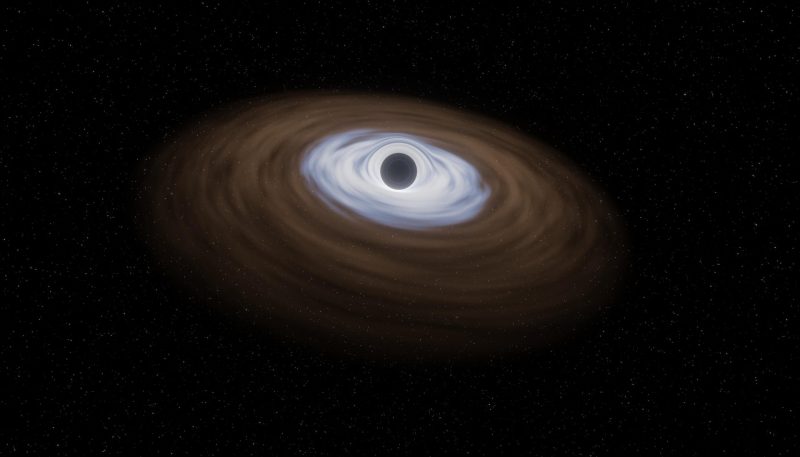
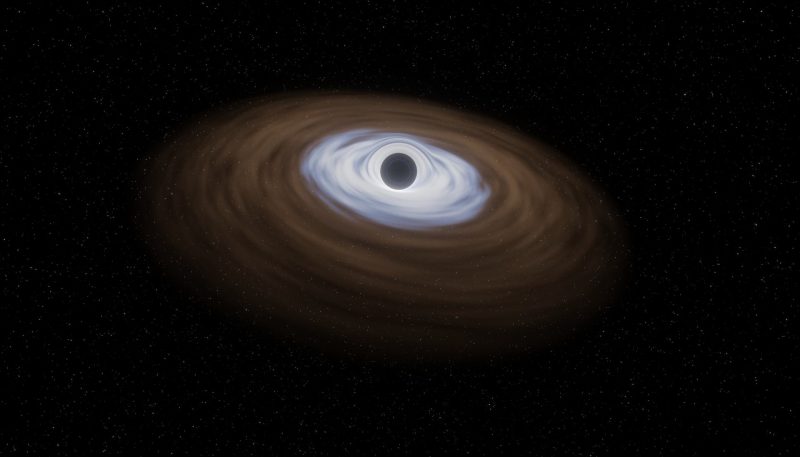
ng data from the MaNGA survey at the Apache Point Observatory, researchers detected this black hole in a dwarf galaxy about 230 million light-years away. Unlike typical supermassive black holes anchored at galactic centers, this one is displaced by nearly 1,000 parsecs (about 3,261 light-years) from the core. Remarkably, it is still actively accreting matter and producing a clear radio jet.
While most known supermassive black holes inhabit galactic nuclei, theoretical models have suggested that in dwarf galaxies—often regarded as “fossil” galaxies—gravitational interactions could eject black holes toward the periphery. This marks the first observationally robust case supporting that scenario.
High-resolution observations with the U.S. Very Long Baseline Array (VLBA) confirmed a brightness temperature of up to a billion Kelvin and parsec-scale jet structures. Long-term variability data ruled out the possibility of a supernova remnant. The black hole is estimated to have a mass of around 300,000 Suns, classifying it as an intermediate-mass black hole.
The finding demonstrates that even outside galactic centers, black holes can efficiently accrete material and influence their surroundings. It also offers new insights into how supermassive black holes may have grown rapidly in the early universe—possibly through “multi-centered” or distributed growth pathways.
Astronomers Discover a Wayward Black Hole Roaming Beyond Its Galaxy's Core
Tags
A mysterious gamma-ray glow at the center of the Milky Way — puzzling scientists for decades—may finally offer the first observational evidence of dark matter. The finding, based on a…
LIGO Detects Record-Breaking Black Hole Merger, Confirming Einstein and Hawking Predictions
Astronomers have detected the strongest gravitational wave signal ever recorded, produced by the collision of two black holes, using the U.S.-based Laser Interferometer Gravitational-Wave Observatory (LIGO). The breakthrough provides the…
A new study suggests that supermassive black holes could function as natural particle colliders, potentially offering a novel path to detect dark matter and other unknown particles. This discovery may…
Since its 2022 launch, NASA's James Webb Space Telescope (JWST) has detected hundreds of mysterious “little red dots” in the early universe—objects appearing within the first billion years after the…
A new study published in Nature Astronomy suggests that the probability of a future collision between the Milky Way and the Andromeda galaxy may be only 50%—significantly lower than previously…