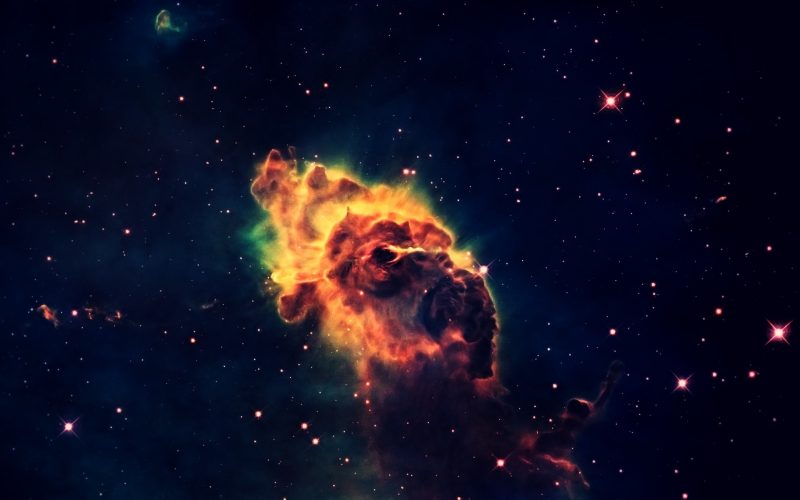
NASA's James Webb Space Telescope (JWST) has observed a rare and dramatic cosmic event: a planet actively spiraling into its host star. This groundbreaking discovery challenges the long-held belief that only expanding stars engulf nearby planets. The findings were recently published in The Astrophysical Journal.
In 2023, astronomers using the Zwicky Transient Facility (ZTF) at Caltech's Palomar Observatory first noticed a sudden brightening of a star located 12,000 light-years from Earth. Initially, scientists attributed the flare to the star entering its red giant phase and consuming a nearby planet—an event consistent with established models. However, new data from JWST contradict this assumption.
The latest analysis reveals that the star has not yet evolved into a red giant. Instead, researchers propose a novel explanation: a Jupiter-sized planet has been gradually losing orbital energy over millions of years due to tidal interactions with its star. This process caused the planet to spiral inward and ultimately plunge into the stellar atmosphere. The resulting impact triggered the ejection of the star's outer gas layers, forming a distinctive cloud of dust.
While the discovery opens new avenues for understanding star-planet interactions, astronomers caution that further observations are needed to confirm the findings. Interstellar dust can distort measurements of stellar brightness, potentially affecting interpretations. With the upcoming Vera C. Rubin Observatory in Chile set to begin operations, scientists anticipate identifying more such events, which could shed light on how common these so-called “planetary suicides” are in the universe.
Webb Telescope Captures Rare "Suicidal" Planet Plunging Into Its Star
Tags
At a joint meeting of the European Planetary Science Congress (EPSC) and the Division for Planetary Sciences (DPS) in Helsinki, scientists from the Space Research Institute of the Austrian Academy…
Astronomers have discovered a mysterious new world at the edge of the solar system—a trans-Neptunian object (TNO) designated 2017 OF201. The discovery, made by researchers from the Institute for Advanced…
Astronomers studying the unusual supernova SN2021yfj have gained rare insights into the internal structure of a massive star, challenging conventional theories of stellar death. The discovery, led by an international…
Astronomers may have detected a giant exoplanet orbiting Alpha Centauri A, a Sun-like star located about 4.3 light-years from Earth. The candidate planet lies within the star's habitable zone and…
Since its 2022 launch, NASA's James Webb Space Telescope (JWST) has detected hundreds of mysterious “little red dots” in the early universe—objects appearing within the first billion years after the…
For the first time, astronomers have observed a planetary system in the earliest known stage of formation outside our solar system—a breakthrough that sheds new light on the origins of…