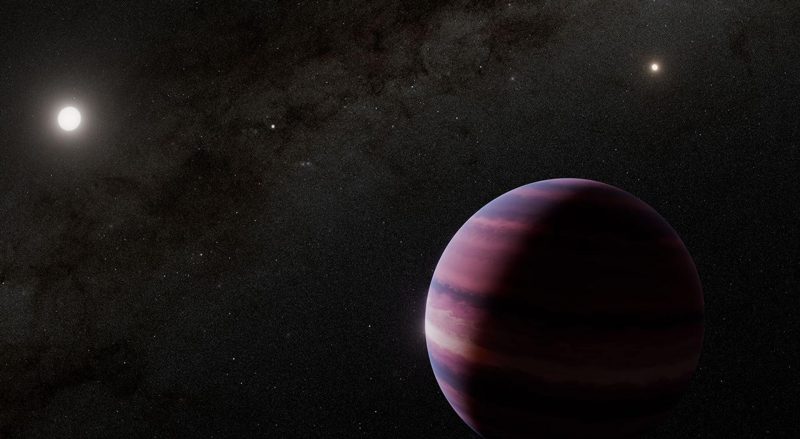
Astronomers may have detected a giant exoplanet orbiting Alpha Centauri A, a Sun-like star located about 4.3 light-years from Earth. The candidate planet lies within the star's habitable zone and could theoretically host liquid water. However, as a likely gas giant, its potential to harbor life is considered low. The findings have been submitted to The Astrophysical Journal Letters.
Alpha Centauri A forms a binary system with Alpha Centauri B, while the red dwarf Proxima Centauri orbits them at a greater distance. To date, Proxima is the only star in the triple system confirmed to host planets. Alpha Centauri A has long been a prime target for planet searches due to its proximity, though its brightness and the glare from its companion star make detection challenging.
A team from the California Institute of Technology used the James Webb Space Telescope's (JWST) infrared capabilities in combination with a coronagraph to block the star's light, capturing signals consistent with a planetary body. Data suggest an orbital distance about twice that of Earth from the Sun, a mass similar to Saturn, and a size close to Jupiter, with an elliptical orbit.
If confirmed, the planet's strong gravity could disturb the habitable zone, affecting the stability of any Earth-like worlds. Two follow-up observations in 2025 failed to detect the object, though simulations indicate it may have been in an undetectable orbital position. The team plans a third observation in August 2026 to verify its existence.
Although unconfirmed, the possible discovery marks a significant advance in exoplanet detection methods. If validated, it would be the first known exoplanet in the habitable zone of a Sun-like star within our galaxy, offering new clues in the search for extraterrestrial life.
Possible Giant Exoplanet Found in Alpha Centauri A's Habitable Zone
Tags
At a joint meeting of the European Planetary Science Congress (EPSC) and the Division for Planetary Sciences (DPS) in Helsinki, scientists from the Space Research Institute of the Austrian Academy…
Astronomers have discovered a mysterious new world at the edge of the solar system—a trans-Neptunian object (TNO) designated 2017 OF201. The discovery, made by researchers from the Institute for Advanced…
Astronomers studying the unusual supernova SN2021yfj have gained rare insights into the internal structure of a massive star, challenging conventional theories of stellar death. The discovery, led by an international…
Since its 2022 launch, NASA's James Webb Space Telescope (JWST) has detected hundreds of mysterious “little red dots” in the early universe—objects appearing within the first billion years after the…
For the first time, astronomers have observed a planetary system in the earliest known stage of formation outside our solar system—a breakthrough that sheds new light on the origins of…