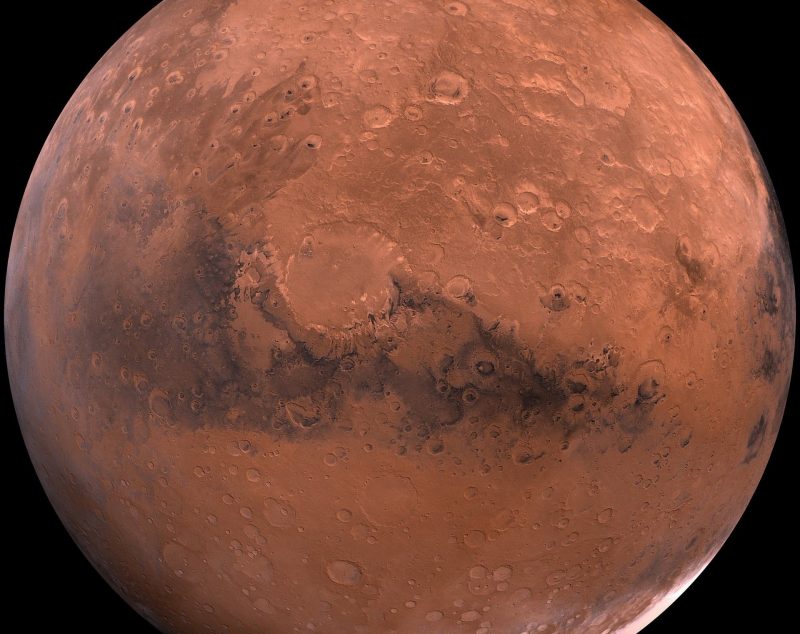
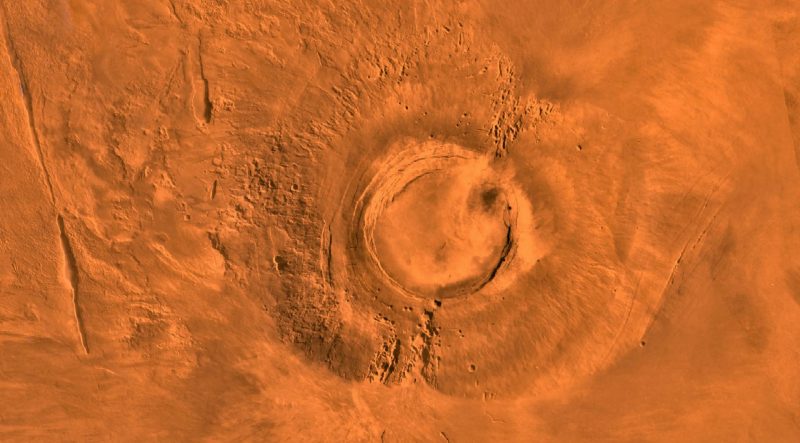
New scientific findings have revealed the presence of frost on the summits of the Tharsis volcano complex on Mars, albeit for a short period after daybreak before it evaporates. The Tharsis volcano complex, situated within Mars' tropical latitudes, is home to some of the largest and tallest volcanoes in our solar system, including the towering Olympus Mons, standing at an impressive 21 kilometers in height.
The frost was identified using high-resolution images captured by the CaSSIS camera aboard the European Space Agency's Trace Gas Orbiter. Independent confirmation of the discovery was obtained through observations from the high-resolution stereo camera on the European Space Agency's Mars Express space probe.
This groundbreaking discovery challenges previous assumptions about the Martian climate, as it is the first time that water frost has been detected near the Martian equator. Earlier beliefs asserted that frost formation on Mars' surface was improbable due to the Sun's energy and the thin equatorial atmosphere. The surface temperatures on Mars can soar to such extremes that frost was not expected to occur atop the volcanoes.
The research indicates that the frost only appears fleetingly during the hours following sunrise before succumbing to evaporation caused by the Sun's intense heat.
Although the frost layer is incredibly thin, measuring about the width of a human hair, it is estimated that approximately 150,000 tons of water circulate between the Martian atmosphere and surface each day. These findings shed new light on the water cycle and dynamics of the Martian environment, urging scientists to reevaluate their understanding of the planet's climatic processes.
Water Frost Found on Martian Volcanoes for the First Time
Tags
For years, biochar was seen mainly as a passive material—removing contaminants from water by adsorption or serving as a support for catalysts. However, new research has revealed that biochar itself…
Earth's climate has swung dramatically between extremes of ice and heat throughout its history. In fact, for much of geological time, Earth has been a warm, ice-free planet. During the Cretaceous…
Scientists have discovered a more than one-billion-year-old asteroid impact structure in the “Dome of the Arctic” region of northwestern Australia. Hidden within volcanic breccia dating back 3.47 billion years, this…
A study published in Science Advances reveals that green algae (Dunaliella salina) can grow in translucent bioplastic chambers under simulated Martian conditions—offering a novel approach to building habitable structures on…

Core Leak? Study Suggests Earth's Core Material May Be Reaching the Surface via Volcanoes
A groundbreaking study from the University of Göttingen challenges long-held assumptions about Earth's internal structure, suggesting that material from the planet's core may be leaking to the surface through volcanic…
For years, dark streaks observed on the surface of Mars were thought to be potential evidence of liquid water, sparking discussions about the planet's habitability. However, a new study suggests…