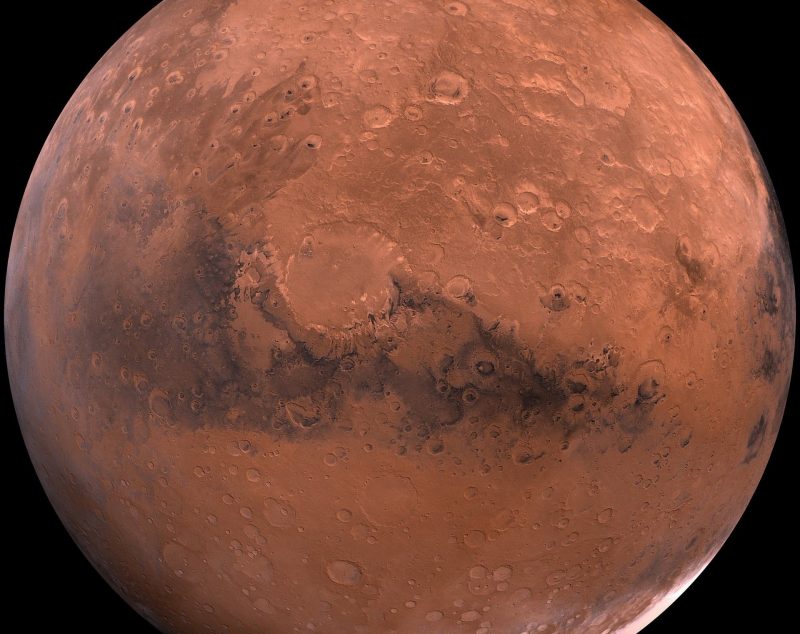
For years, dark streaks observed on the surface of Mars were thought to be potential evidence of liquid water, sparking discussions about the planet's habitability. However, a new study suggests these features are more likely the result of wind activity and dust movement rather than flowing water.
Scientists from Brown University and the University of Bern used machine learning to analyze over 86,000 high-resolution images of Mars, producing the first global map of more than 500,000 streak-like features. By comparing this data with environmental factors such as temperature, wind speed, and dust deposition, the researchers found no correlation with liquid water. Instead, the streaks are strongly linked to high winds and dust activity.
First discovered by NASA's Viking mission in the 1970s, some of these features—known as recurring slope lineae (RSL)—appear seasonally, while others are more permanent. Earlier hypotheses suggested they might be formed by melting subsurface ice or briny water. The new findings, however, support dry processes such as dust avalanches, dust devils, or rockfalls.
The study has important implications for future Mars exploration. If these streaked regions do not harbor liquid water, mission planners can worry less about contaminating potential microbial habitats, allowing for more flexible target selection. The researchers emphasize that large-scale data analysis enables scientists to rule out incorrect assumptions before deploying rovers, improving the efficiency of planetary missions.
Published in Nature Communications, the study offers a fresh perspective on modern Martian geology and lowers the likelihood that these streaks indicate current life on Mars.
New Study Debunks Liquid Water Theory Behind Mars' Mysterious Streaks
Tags
At a joint meeting of the European Planetary Science Congress (EPSC) and the Division for Planetary Sciences (DPS) in Helsinki, scientists from the Space Research Institute of the Austrian Academy…
For years, biochar was seen mainly as a passive material—removing contaminants from water by adsorption or serving as a support for catalysts. However, new research has revealed that biochar itself…

Astronomers have discovered a mysterious new world at the edge of the solar system—a trans-Neptunian object (TNO) designated 2017 OF201. The discovery, made by researchers from the Institute for Advanced…
Astronomers may have detected a giant exoplanet orbiting Alpha Centauri A, a Sun-like star located about 4.3 light-years from Earth. The candidate planet lies within the star's habitable zone and…
For the first time, astronomers have observed a planetary system in the earliest known stage of formation outside our solar system—a breakthrough that sheds new light on the origins of…
Scientists have discovered a more than one-billion-year-old asteroid impact structure in the “Dome of the Arctic” region of northwestern Australia. Hidden within volcanic breccia dating back 3.47 billion years, this…