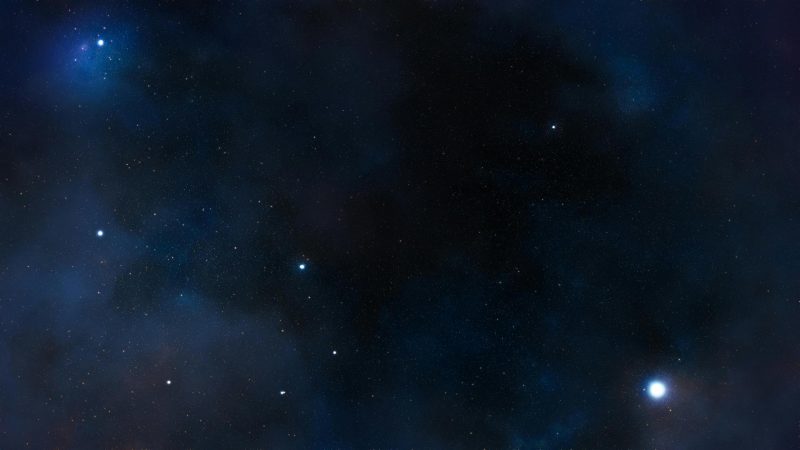
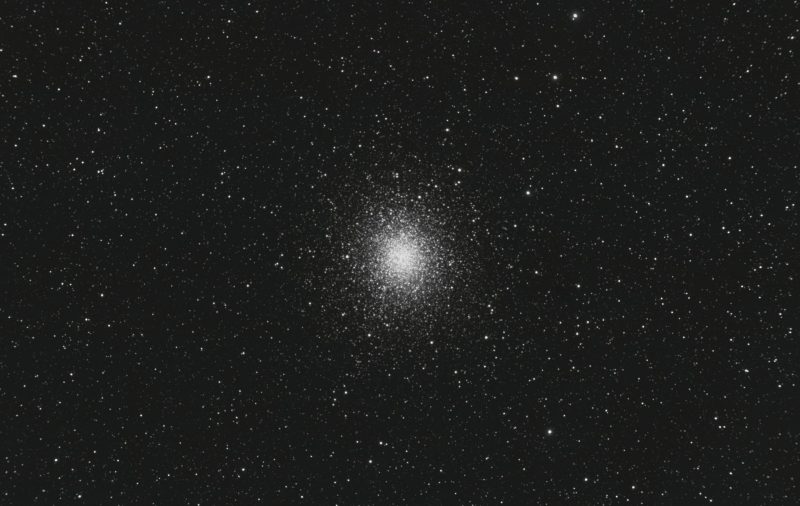
In the dark expanse of the sky, Omega Centauri, a visibly striking cluster in the Milky Way, stands out as one of the brightest star clusters, harboring millions of ancient stars.
A recent study has revealed that contrary to previous reports, there is no evidence to suggest the presence of intermediate-mass black holes in Omega Centauri. Instead, a much smaller population of black holes appears to be traversing the dense core of this star cluster, offering a plausible explanation for the motion and distribution of numerous ancient stars.
Researchers assert that current analyses support the existence of black holes at the center of the cluster that are comparable in mass to individual stars, rather than intermediate-mass black holes. They further indicate that the presence of approximately 10,000 to 20,000 solar-mass black holes at the cluster's core—amounting to 200,000 to 300,000 times the mass of the Sun—can account for these observational findings.
While this study does not entirely rule out the possibility of intermediate-mass black holes, if they do exist, their mass is considerably smaller than previously believed. As a result, the research team concludes that there are no black holes in the cluster exceeding 6,000 times the mass of the Sun.
Rethinking Intermediate-Mass Black Holes in Omega Centauri
Tags
ng data from the MaNGA survey at the Apache Point Observatory, researchers detected this black hole in a dwarf galaxy about 230 million light-years away. Unlike typical supermassive black holes…
LIGO Detects Record-Breaking Black Hole Merger, Confirming Einstein and Hawking Predictions
Astronomers have detected the strongest gravitational wave signal ever recorded, produced by the collision of two black holes, using the U.S.-based Laser Interferometer Gravitational-Wave Observatory (LIGO). The breakthrough provides the…
A new study suggests that supermassive black holes could function as natural particle colliders, potentially offering a novel path to detect dark matter and other unknown particles. This discovery may…
Since its 2022 launch, NASA's James Webb Space Telescope (JWST) has detected hundreds of mysterious “little red dots” in the early universe—objects appearing within the first billion years after the…
Supermassive Black Hole in Nearby Galaxy Launches High-Speed Jets into Intergalactic Space
The European Southern Observatory (ESO) has announced a significant discovery: a supermassive black hole at the center of the spiral galaxy NGC 4945 is not only actively consuming matter but…
Recent astronomical observations suggest that dark energy—the mysterious force driving the accelerated expansion of the universe—may not be constant, a revelation that could reshape the foundations of modern physics. An international…