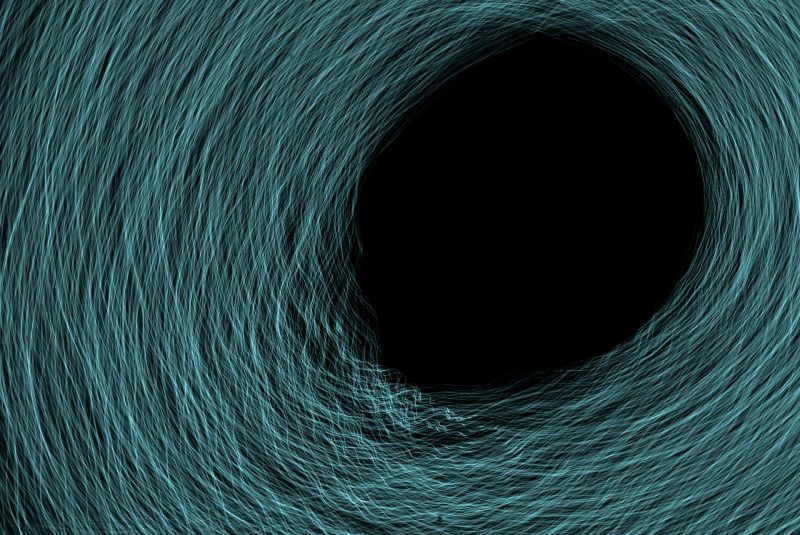
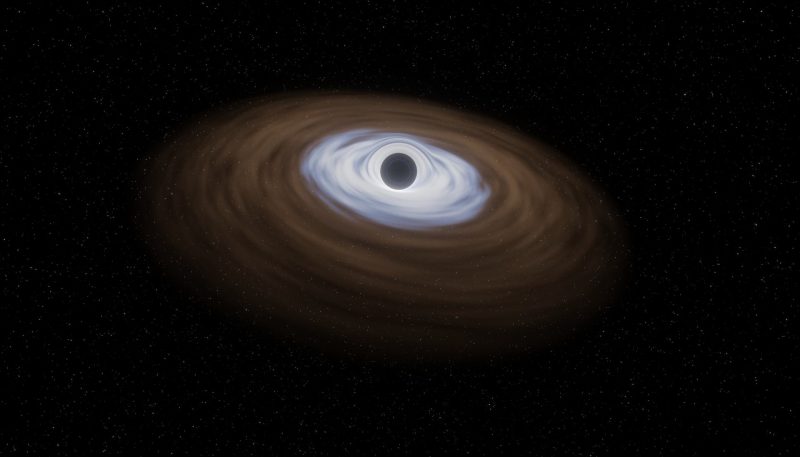
Scientists hypothesize the existence of an ancient type of black hole that could be deeply embedded in the cosmos, invisible and challenging to detect, yet profoundly influential on the evolution of the universe. These "primordial black holes" share similarities with the black holes we know but differ significantly in origin. Unlike black holes formed from collapsing stars or the supermassive ones at galactic centers, primordial black holes are thought to have emerged in the universe's earliest moments, shortly after the Big Bang—long before stars and galaxies came into being.
Interest in primordial black holes dates back to the 1960s, when scientists first speculated about their existence. Stephen Hawking later published groundbreaking research on the topic and, in the process, introduced the famous Hawking radiation theory. This theory posits that black holes can gradually lose mass by emitting faint radiation over time.
Decades of theoretical exploration have made scientists increasingly optimistic about the possibility of detecting primordial black holes. In recent years, interest in this field has surged, with new generations of researchers collaborating with seasoned experts to uncover observational evidence of these elusive entities. If they do exist, primordial black holes could influence the universe in various ways, emitting faint Hawking radiation, bending starlight, colliding with other celestial bodies, or even consuming stars from within.
The potential discovery of primordial black holes could also shed light on one of cosmology's greatest mysteries: the nature of dark matter. Dark matter’s gravitational effects hold galaxies together and underpin the observable structure of the universe. Yet, despite decades of investigation, its true identity remains unknown. Primordial black holes might provide a critical piece of this puzzle, offering a revolutionary perspective on the enigmatic substance that shapes our cosmos.
Primordial Black Holes: Hidden Relics of the Early Universe
Tags
A mysterious gamma-ray glow at the center of the Milky Way — puzzling scientists for decades—may finally offer the first observational evidence of dark matter. The finding, based on a…
ng data from the MaNGA survey at the Apache Point Observatory, researchers detected this black hole in a dwarf galaxy about 230 million light-years away. Unlike typical supermassive black holes…
LIGO Detects Record-Breaking Black Hole Merger, Confirming Einstein and Hawking Predictions
Astronomers have detected the strongest gravitational wave signal ever recorded, produced by the collision of two black holes, using the U.S.-based Laser Interferometer Gravitational-Wave Observatory (LIGO). The breakthrough provides the…
A new study suggests that supermassive black holes could function as natural particle colliders, potentially offering a novel path to detect dark matter and other unknown particles. This discovery may…
Since its 2022 launch, NASA's James Webb Space Telescope (JWST) has detected hundreds of mysterious “little red dots” in the early universe—objects appearing within the first billion years after the…
Supermassive Black Hole in Nearby Galaxy Launches High-Speed Jets into Intergalactic Space
The European Southern Observatory (ESO) has announced a significant discovery: a supermassive black hole at the center of the spiral galaxy NGC 4945 is not only actively consuming matter but…