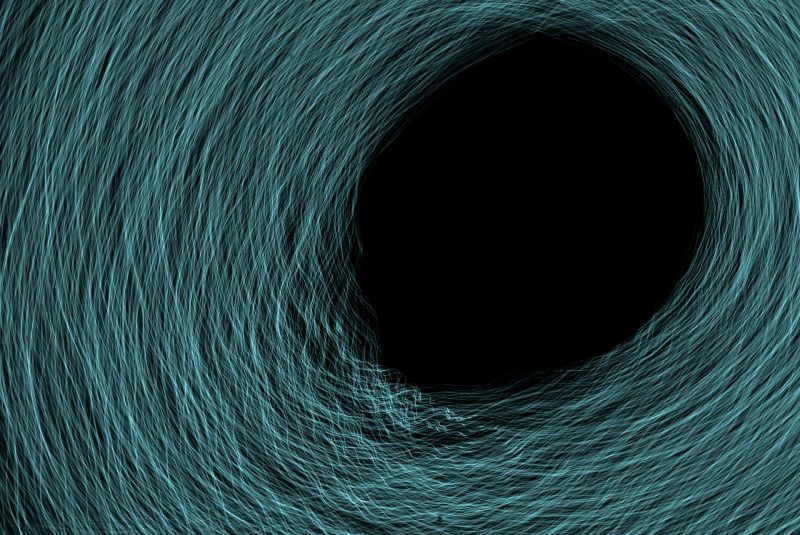
A mysterious gamma-ray glow at the center of the Milky Way — puzzling scientists for decades—may finally offer the first observational evidence of dark matter. The finding, based on a combination of supercomputer simulations and space telescope data, brings new hope in unraveling one of the universe's greatest mysteries.
Dark matter is thought to make up most of the universe's total mass and plays a vital role in holding galaxies together. Yet because it neither emits nor interacts with light, detecting it directly has proven extremely difficult. The Milky Way's central gamma-ray excess has long been attributed to two competing explanations: collisions and annihilation of dark matter particles, or emissions from a vast population of millisecond pulsars.
A new study published in Physical Review Letters marks a key step forward. Led by researchers from the Leibniz Institute for Astrophysics Potsdam in Germany, the team used a supercomputer to create the first model of dark matter distribution that incorporates the Milky Way's formation history. The simulation suggests that in the galaxy's dense core, frequent dark matter collisions could produce gamma rays with a pattern strikingly similar to what NASA's Fermi Gamma-ray Space Telescope has actually observed.
Still, scientists are cautious. The pulsar hypothesis could also account for some observed features—but it would require far more pulsars than have ever been detected, leaving the idea open to challenge.
The upcoming Cherenkov Telescope Array Observatory (CTAO), now under construction, could provide decisive evidence. With unprecedented sensitivity and resolution, CTAO will be able to distinguish the energy signatures of gamma rays, helping determine whether the mysterious glow arises from dark matter interactions or pulsar emissions.
Meanwhile, the research team is applying the same dark matter model to dwarf galaxies orbiting the Milky Way. By comparing predictions with future high-resolution observations, scientists hope to further test the dark matter hypothesis. Whatever the outcome, this pursuit is bringing humanity closer to understanding the true structure of galaxies—and the hidden nature of our universe.
Mysterious Gamma-Ray Glow Near Milky Way's Core May Be First Hint of Dark Matter
Tags
ng data from the MaNGA survey at the Apache Point Observatory, researchers detected this black hole in a dwarf galaxy about 230 million light-years away. Unlike typical supermassive black holes…
A new study suggests that supermassive black holes could function as natural particle colliders, potentially offering a novel path to detect dark matter and other unknown particles. This discovery may…
Since its 2022 launch, NASA's James Webb Space Telescope (JWST) has detected hundreds of mysterious “little red dots” in the early universe—objects appearing within the first billion years after the…
A new study published in Nature Astronomy suggests that the probability of a future collision between the Milky Way and the Andromeda galaxy may be only 50%—significantly lower than previously…
Supermassive Black Hole in Nearby Galaxy Launches High-Speed Jets into Intergalactic Space
The European Southern Observatory (ESO) has announced a significant discovery: a supermassive black hole at the center of the spiral galaxy NGC 4945 is not only actively consuming matter but…