Scientists at NASA have made an intriguing discovery on Mars—a peculiar crater that may serve as an entry point to an underground shelter for future human explorers. Mars, with its distinct features compared to Earth, necessitates protective shelters for potential astronauts to shield them from the planet's temperature fluctuations, radiation, and dust storms.
Similar to Earth and the Moon, Mars is speculated to possess vast underground lava tubes that could potentially serve as habitats for explorers. Sections of collapsed lava tubes, referred to as skylights, might serve as portals to these subterranean shelters.
Recently, NASA's Mars Reconnaissance Orbiter (MRO) employed the High-Resolution Imaging Science Experiment (HiRISE) camera to capture an image revealing a remarkable feature on the Martian surface. This image showcases a small hole in the Arsia Mons volcano region, part of the Tarsismons volcanic complex on Mars, which consists of three dormant volcanoes.
Scientists propose that this hole might either be a collapsed skylight or the entrance to an underground lava tube, although uncertainties remain. The illuminated sidewall visible in the image suggests that it is more than a mere cylindrical hole.
Alternatively, the pit in the image might be a shaft rather than the entrance to a lava tube. Similar shafts have been observed on volcanoes in Hawaii, which are not associated with extensive caves or lava tubes but are formed through deeper underground collapses.
NASA Discovers Possible Entrance to Underground Shelter on Mars
Tags
A new NASA study indicates that Saturn's largest moon, Titan, may host naturally forming primitive cell-like structures called vesicles within its liquid hydrocarbon lakes. The finding offers fresh insight into…
Scientists have discovered a more than one-billion-year-old asteroid impact structure in the “Dome of the Arctic” region of northwestern Australia. Hidden within volcanic breccia dating back 3.47 billion years, this…
A study published in Science Advances reveals that green algae (Dunaliella salina) can grow in translucent bioplastic chambers under simulated Martian conditions—offering a novel approach to building habitable structures on…

For years, dark streaks observed on the surface of Mars were thought to be potential evidence of liquid water, sparking discussions about the planet's habitability. However, a new study suggests…
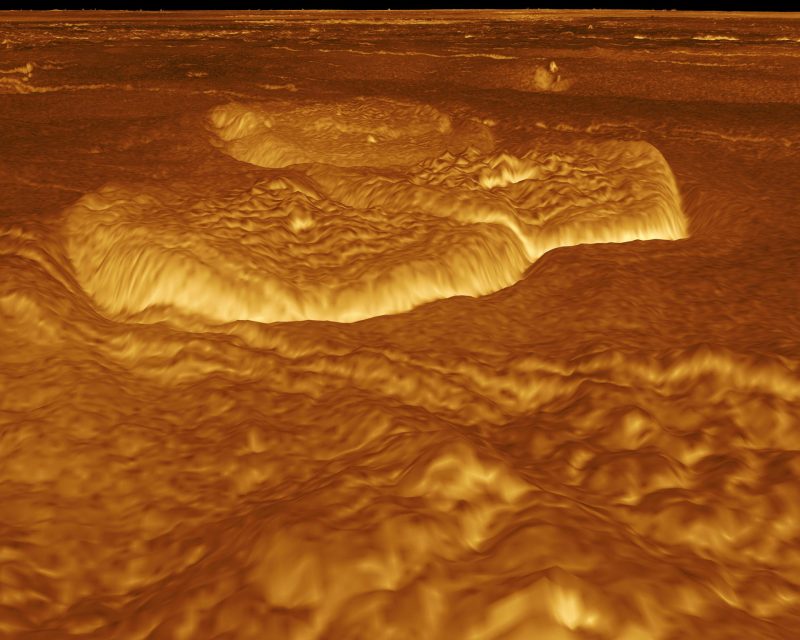
A recent NASA study reveals that large circular features on Venus—known as coronae—may be evidence of ongoing geological activity. The findings, published in Science Advances, are based on data collected…
NASA has recently completed ground engine performance tests for the X-59 Quiet Supersonic Technology (QueSST) demonstrator—a key step toward mitigating the disruptive sonic booms produced by supersonic aircraft. In collaboration…