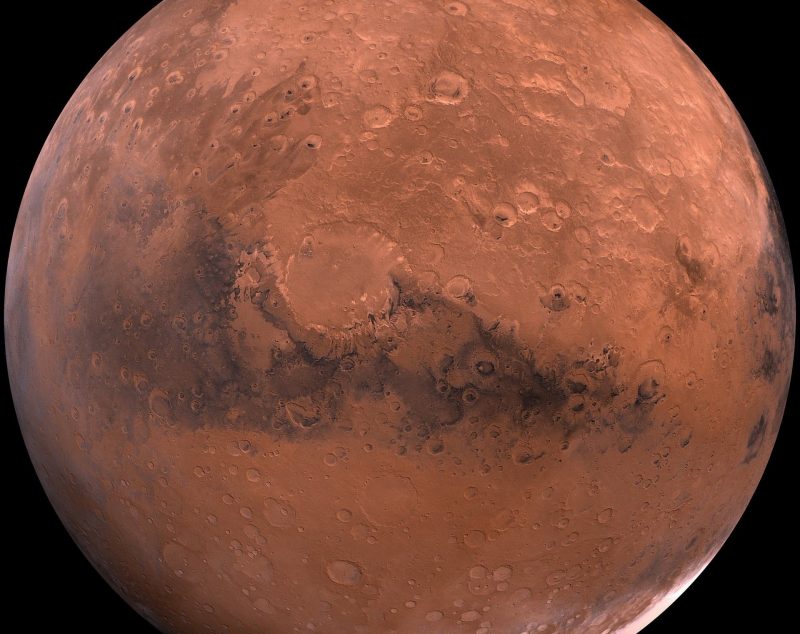
More and more evidence suggests that billions of years ago, liquid water may have flowed on the surface of Mars. If water was present, there must have been a thick atmosphere to prevent it from freezing. However, around 3.5 billion years ago, water dried up on Mars, and the atmosphere rich in carbon dioxide rapidly thinned, leaving behind the thin Martian atmosphere we see today.
Where did Mars' atmosphere go? This question has been one of the core mysteries in Mars' 4.6 billion-year history.
Two geologists from MIT propose that the answer might lie within the clays of Mars. In a paper published in Science Advances, they speculate that much of Mars' lost atmosphere might be locked in the clay covering the Martian crust.
The research team suggests that when water was present on Mars, liquid water could have passed through certain types of rocks, triggering a series of slow chemical reactions that gradually pulled carbon dioxide out of the atmosphere and converted it into a form of carbon that could be stored in Martian clays for billions of years.
The researchers also propose that this sequestered carbon dioxide on Mars could potentially be extracted in the future and converted into propellant, providing fuel for future missions between Mars and Earth.
Tags
At a joint meeting of the European Planetary Science Congress (EPSC) and the Division for Planetary Sciences (DPS) in Helsinki, scientists from the Space Research Institute of the Austrian Academy…
For years, biochar was seen mainly as a passive material—removing contaminants from water by adsorption or serving as a support for catalysts. However, new research has revealed that biochar itself…
Earth's climate has swung dramatically between extremes of ice and heat throughout its history. In fact, for much of geological time, Earth has been a warm, ice-free planet. During the Cretaceous…

MIT Boosts Key Photosynthesis Enzyme Efficiency by 25%, Paving Way for Higher Crop Yields
A research team at the Massachusetts Institute of Technology (MIT) has significantly enhanced the efficiency of Rubisco, a crucial enzyme in photosynthesis, using an advanced technique known as continuous directed…
Scientists have discovered a more than one-billion-year-old asteroid impact structure in the “Dome of the Arctic” region of northwestern Australia. Hidden within volcanic breccia dating back 3.47 billion years, this…
A study published in Science Advances reveals that green algae (Dunaliella salina) can grow in translucent bioplastic chambers under simulated Martian conditions—offering a novel approach to building habitable structures on…