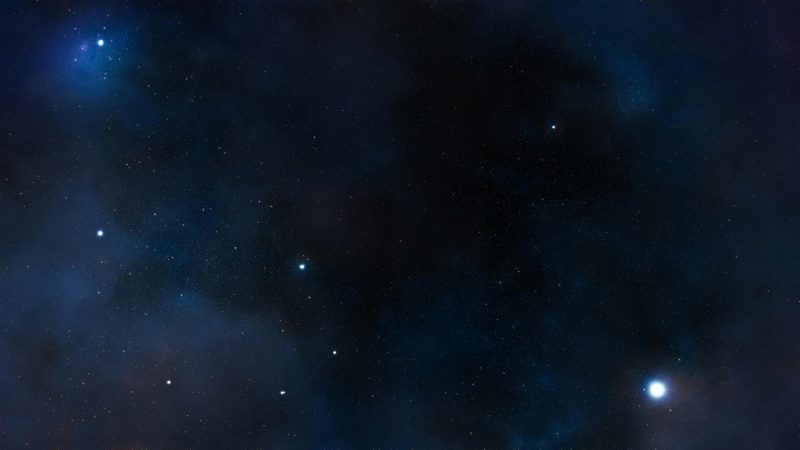
How small can a star be? Astronomers using NASA's James Webb Space Telescope (JWST) to study star-forming regions near the Milky Way may have spotted the smallest brown dwarf yet. Brown dwarfs form like stars but don't have enough mass to start hydrogen fusion in their cores.
Previously, three research groups had identified around 12 brown dwarfs with masses between 3 to 8 times that of Jupiter, asserting that smaller brown dwarfs were unlikely. The observed brown dwarfs aligned with the predicted lower mass limit from stellar formation theories, boosting astronomers' confidence that they might have encountered the smallest naturally occurring brown dwarf.
However, a controversial, unpublished study by a team from the European Space Agency claims to have discovered pairs of brown dwarfs nearly the size of Jupiter, challenging established models of star formation. In the Quadrilateral Cluster at the heart of the Orion Nebula, approximately 1,400 light-years away, the team noted 42 brown dwarfs orbiting in pairs, some nearly as light as Jupiter. They dubbed these peculiar celestial bodies "Jupiter Mass Binary Objects (JuMBOs)."
Many astronomers define brown dwarfs based on the material they burn. Celestial bodies with masses greater than 70 times that of Jupiter possess sufficient gravity to trigger hydrogen fusion and are classified as traditional stars. Brown dwarfs with masses between 13 and 70 times that of Jupiter can only fuse a hydrogen isotope called deuterium, sustaining weak nuclear burning for millions of years.
Distinguishing smaller brown dwarfs from planets requires observing how they form. Although their final masses may be as large as 10 Jupiters, planets always arise from gas and dust disks surrounding stars, whereas stars, including brown dwarfs, form independently within vast collapsing gas clouds. Theoretically, the smallest brown dwarfs are believed to have masses approximately 7 times that of Jupiter, or 0.007 times that of the Sun.
Unveiling the Smallest Stars: Brown Dwarfs and JuMBOs in Focus
Tags
Astronomers studying the unusual supernova SN2021yfj have gained rare insights into the internal structure of a massive star, challenging conventional theories of stellar death. The discovery, led by an international…
Astronomers may have detected a giant exoplanet orbiting Alpha Centauri A, a Sun-like star located about 4.3 light-years from Earth. The candidate planet lies within the star's habitable zone and…
Since its 2022 launch, NASA's James Webb Space Telescope (JWST) has detected hundreds of mysterious “little red dots” in the early universe—objects appearing within the first billion years after the…
For the first time, astronomers have observed a planetary system in the earliest known stage of formation outside our solar system—a breakthrough that sheds new light on the origins of…
Using the Very Large Array (VLA) of the U.S. National Science Foundation’s National Radio Astronomy Observatory (NSF NRAO), astronomers have, for the first time, directly observed a dramatic accretion process…
An international team of astronomers has discovered that "super-Earths"—planets several times the mass of Earth—can orbit their host stars at vast distances, much like gas giants such as Jupiter. This…