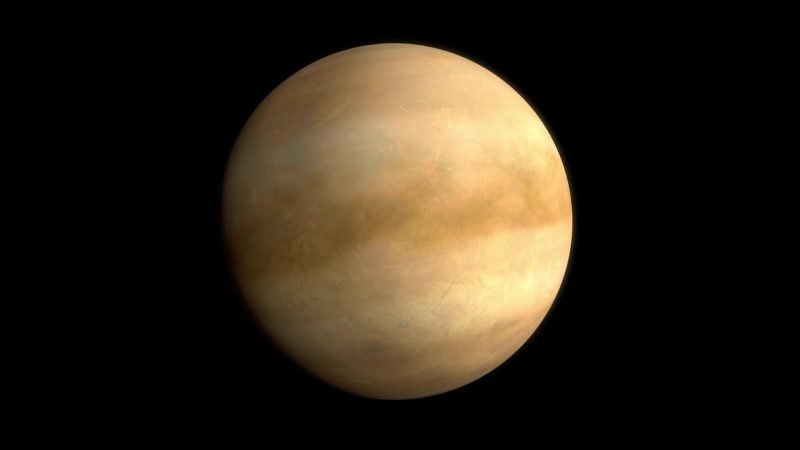
Two main theories exist regarding the environmental evolution of Venus since its formation 4.6 billion years ago. One suggests that Venus's surface temperature once allowed for the existence of liquid water but later extreme greenhouse effects triggered by extensive volcanic activity turned Venus into an inferno. The other theory posits that Venus has been too hot since its inception, never experiencing liquid water.
Researchers from the University of Cambridge in the UK have calculated the destruction rates of water, carbon dioxide, and carbonyl sulfide molecules in Venus's atmosphere, which need to be replenished through volcanic gas emissions to maintain atmospheric stability. Volcanic activity offers crucial clues to understanding the internal structure of Venus and other rocky planets. As magma rises from Venus's mantle to the surface, gases are released into the atmosphere. On Earth, volcanic emissions are primarily water vapor due to the planet's water-rich interior. However, the study reveals that the water content in Venus's volcanic gases is at most only 6%, a key detail for sustaining its atmosphere.
Published in the journal "Nature Astronomy," these findings hold significant implications for understanding Earth's uniqueness and searching for life-sustaining planets beyond our solar system. Despite the similarities between many exoplanets and Venus, this research underscores the importance of astronomers focusing on exoplanets more akin to Earth.
Theory of Liquid Water on Venus's Surface Challenged by New Research
Tags
At a joint meeting of the European Planetary Science Congress (EPSC) and the Division for Planetary Sciences (DPS) in Helsinki, scientists from the Space Research Institute of the Austrian Academy…
For years, biochar was seen mainly as a passive material—removing contaminants from water by adsorption or serving as a support for catalysts. However, new research has revealed that biochar itself…
Astronomers have discovered a mysterious new world at the edge of the solar system—a trans-Neptunian object (TNO) designated 2017 OF201. The discovery, made by researchers from the Institute for Advanced…
Astronomers may have detected a giant exoplanet orbiting Alpha Centauri A, a Sun-like star located about 4.3 light-years from Earth. The candidate planet lies within the star's habitable zone and…
Earth's climate has swung dramatically between extremes of ice and heat throughout its history. In fact, for much of geological time, Earth has been a warm, ice-free planet. During the Cretaceous…

For the first time, astronomers have observed a planetary system in the earliest known stage of formation outside our solar system—a breakthrough that sheds new light on the origins of…