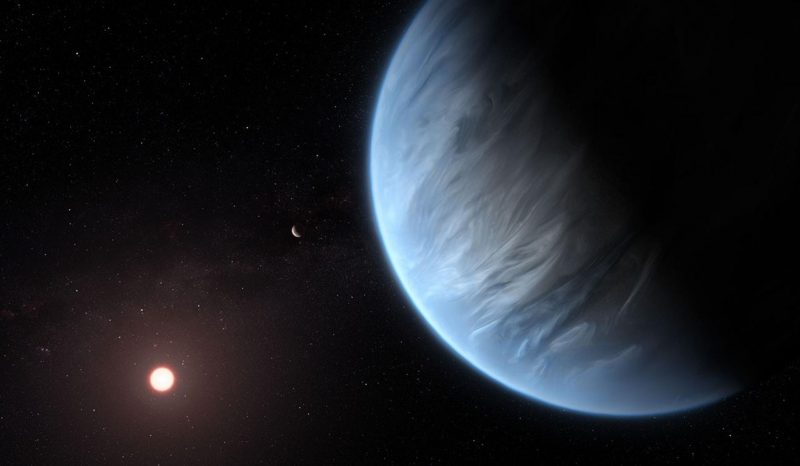
A team of astronomers from the University of Cambridge has reported the potential detection of life-related molecules in the atmosphere of exoplanet K2-18 b, located approximately 124 light-years from Earth. The discovery, made using the James Webb Space Telescope (JWST), has generated widespread interest but also significant skepticism within the scientific community.
The researchers claim to have identified traces of dimethyl sulfide (DMS) and dimethyl disulfide (DMDS) — organic compounds typically produced by marine plankton and other biological processes on Earth. According to the Cambridge team, the signals are clearer than those observed in 2023 and have a low probability (0.3%) of being due to random chance.
However, experts from institutions including Johns Hopkins University caution that the signals may be the result of noise or statistical fluctuations. Scientists from the Max Planck Institute for Astronomy argue that the detection is nearing JWST's sensitivity limits. Moreover, some studies suggest that DMS can be generated through non-biological processes, and the European Space Agency has even detected the molecule on lifeless comets.
There is also ongoing debate about the nature of K2-18 b itself. While some models from the University of Washington describe the planet as a barren hydrogen-rich mini-Neptune, the Cambridge team posits that certain hydrogen-enveloped exoplanets could potentially support life. They acknowledge, however, that more research is needed to confirm these possibilities.
Experts stress that biological origins must be ruled out conclusively before such molecules can be considered evidence of life. The broader scientific consensus holds that further confirmation from independent JWST observations will be essential. Despite the uncertainty, the findings underscore the growing significance of exoplanetary atmospheric research and offer promising avenues for the search for extraterrestrial life.
Possible Signs of Life Detected on Distant Exoplanet Spark Scientific Debate
Tags
A groundbreaking study by scientists from Pennsylvania State University and Columbia University, recently published in Nature Geoscience, reveals that Earth's continents owe their long-term stability—and their role as the cradle…

How did life arise from nothing? A new mathematical study offers a surprising perspective on this ultimate question. Researchers at Imperial College London suggest that the probability of life naturally…
Astronomers may have detected a giant exoplanet orbiting Alpha Centauri A, a Sun-like star located about 4.3 light-years from Earth. The candidate planet lies within the star's habitable zone and…
Since its 2022 launch, NASA's James Webb Space Telescope (JWST) has detected hundreds of mysterious “little red dots” in the early universe—objects appearing within the first billion years after the…
For the first time, astronomers have observed a planetary system in the earliest known stage of formation outside our solar system—a breakthrough that sheds new light on the origins of…