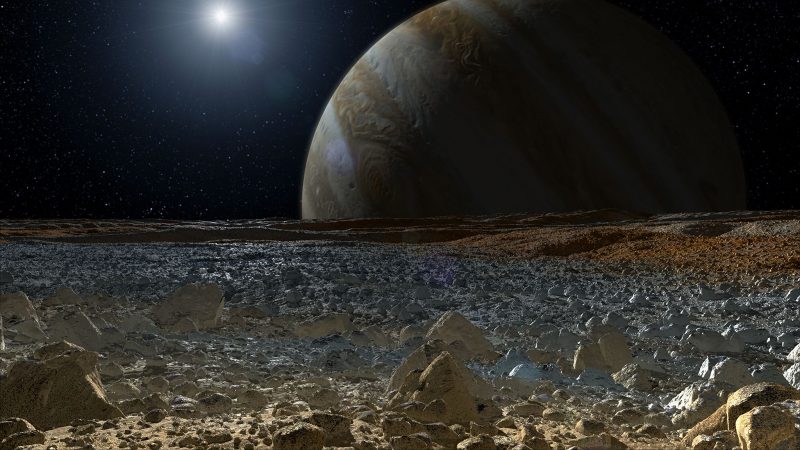
Jupiter's moon Europa has long been regarded as a potential hotbed for extraterrestrial life due to its hidden ocean beneath an icy crust. NASA's upcoming Europa Clipper mission, set to launch later this year at a cost of $5 billion, aims to study this mysterious ocean and potentially collect samples. However, recent modeling studies presented at the 55th Lunar and Planetary Science Conference in Texas have cast doubt on the moon's geological activity.
According to the studies, Europa's rocky interior appears to be geologically dormant. This means that magma might not be able to penetrate the seafloor to create hydrothermal vents, which are believed to be essential for supporting early life, as seen on Earth. Furthermore, the rocky crust of Europa seems resistant to earthquake ruptures, impeding the emergence of fresh rock. Without the combination of heat and fresh rock to drive geochemical reactions in the ocean, creating conditions conducive to life becomes highly unlikely.
The implications of these findings have left scientists disheartened. Austin Green, a planetary scientist at NASA's Jet Propulsion Laboratory, acknowledges the significance of volcanic activity for habitability. He explains that if Europa's oceans rely on such activity, they would be inhospitable to life. The research involved simulating melted rocks in Europa's mantle to determine the height to which magma could rise in the lithosphere. The results revealed that generating melt is challenging and restricts its ascent to a few kilometers, well below the seafloor.
These studies deal a significant blow to the prospects of habitability on Europa. Recent measurements published in Nature Astronomy, based on data from NASA's Juno spacecraft's flyby of Europa, indicate that radiation bombardment on the icy shell produces considerably less oxygen in the subsurface ocean than previously believed.
Furthermore, the journal "Science" features research published in 2023 that highlights the failure to detect eruption plumes using NASA's James Webb Space Telescope, raising doubts about the Hubble Space Telescope's earlier discovery of potential geyser activity on Europa.
Paul Byrne, a planetary scientist from the University of Washington in Louis, presented new research at the conference focusing on the deep rocks concealed beneath Europa's ice and oceans, approximately 130 kilometers below the moon's surface. Since most of Europa's volume is comprised of rock, Byrne and his team assessed the strength of the lithosphere, the hard silicate rock that forms the moon's uppermost layer. Comparing the calculated strength of the rocks with the pressure exerted by Jupiter's gravity and the moon's cooling over time, the researchers concluded that Europa's past environment might have been more suitable for life. However, the current conditions on the moon's ocean floor make it challenging to find any circumstances capable of sustaining life.
As NASA's Europa Clipper mission prepares for launch, scientists grapple with the disheartening reality that the habitability of Europa's ocean may be far more limited than previously anticipated. The mission's success in uncovering the potential for life on this enigmatic moon remains uncertain, but the scientific community persists in its pursuit of understanding the mysteries that lie within the depths of Europa's captivating ocean.
Europa Clipper Mission Faces Challenges in Search for Life on Jupiter's Moon
Tags
Recent astronomical observations suggest that dark energy—the mysterious force driving the accelerated expansion of the universe—may not be constant, a revelation that could reshape the foundations of modern physics. An international…
Scientists have captured the most detailed image yet of the universe just 380,000 years after the Big Bang, using the Atacama Cosmology Telescope (ACT). This groundbreaking observation reveals the motion…
Countless stars pepper the universe, yet why does space appear so dark? This question has plagued humanity for centuries and is known in astronomy as "Olbers' Paradox". An associate professor of…
For decades, planetary scientists have believed that Jupiter's moon Europa may harbor potential habitats for extraterrestrial life. Beneath Europa's icy crust lies a vast salty ocean. However, researchers reported at…
An international research team has utilized cosmic-scale observational data to verify the gravitational predictions of Einstein's general theory of relativity. Scientists employed the Dark Energy Spectroscopic Instrument (DESI) in the creation…
In the dark expanse of the sky, Omega Centauri, a visibly striking cluster in the Milky Way, stands out as one of the brightest star clusters, harboring millions of ancient…