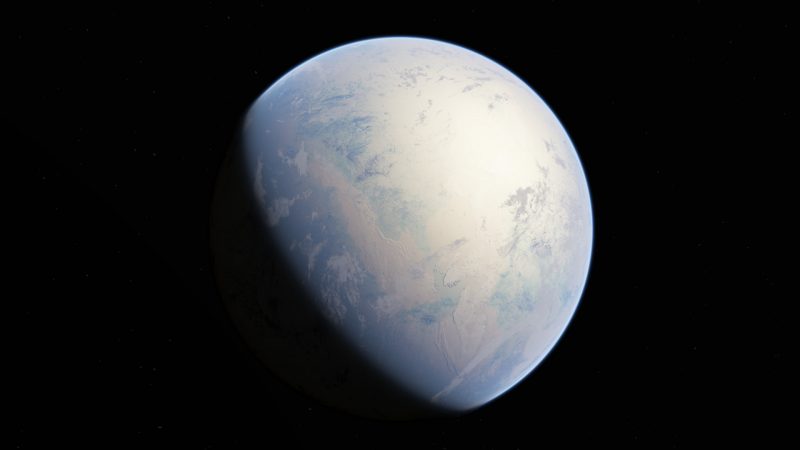
A research team led by University College London (UCL) has discovered that the geological formations of the Askaig Harbour in Ireland and Scotland may hold a crucial geological record of the "Snowball Earth", offering unique insights into the precursor to the evolution of complex life. The term "Snowball Earth" refers to a pivotal phase in Earth's history when the entire planet was covered in ice and snow.
Published in the Geological Society of London's journal, the study reveals that the Askaig Harbour formations are composed of rock layers up to 1.1 kilometers thick, possibly dating back to the Sturtian glaciation period between 662 to 720 million years ago—the first of Earth's two major ice ages, believed to have triggered the development of complex multicellular life.
An exposed rock in the Askaig Harbour formations on the Scottish Garvellachs Islands showcases the transition from a warm tropical environment to the "Snowball Earth" state. Unlike rocks formed in other regions during the same period, these rocks underwent this transition as ancient glaciers scraped the underlying layers.
In this new study, the research team analyzed zircon minerals in the Askaig Harbour formations and the underlying 70-meter-thick Garbh Eileach formations. Zircon minerals contain radioactive element uranium, which decays into lead at a stable rate, allowing for precise dating. Zircon and other geochemical evidence suggest that these formations were deposited between 662 to 720 million years ago.
What is Snowball Earth?
Snowball Earth refers to periods in Earth's history, particularly during the Cryogenian period around 700 to 650 million years ago, when the planet's surface was almost entirely covered by ice and snow. These extreme glaciations were primarily triggered by significant drops in global temperatures, likely due to factors such as reduced solar radiation, changes in volcanic activity, and shifts in atmospheric composition. These events had profound effects on Earth's climate, geology, and the evolution of life.
Discovery of 'Snowball Earth' Clues in Irish and Scottish Geological Formations
Tags
A groundbreaking study by scientists from Pennsylvania State University and Columbia University, recently published in Nature Geoscience, reveals that Earth's continents owe their long-term stability—and their role as the cradle…

For the first time, astronomers have observed a planetary system in the earliest known stage of formation outside our solar system—a breakthrough that sheds new light on the origins of…
Core Leak? Study Suggests Earth's Core Material May Be Reaching the Surface via Volcanoes
A groundbreaking study from the University of Göttingen challenges long-held assumptions about Earth's internal structure, suggesting that material from the planet's core may be leaking to the surface through volcanic…
A provocative new theory has sparked interest and debate in the scientific community: Earth's rotation within its geomagnetic field might be harnessed to generate electricity. Although the idea remains contentious,…
Earth's atmosphere has undergone dramatic changes over time, yet the gas bubbles trapped in polar ice cores can only preserve atmospheric compositions from the past six million years—less than 0.2%…
A molehill may seem insignificant compared to a mountain, but over time, the burrowing, digging, and trampling activities of animals—such as moles, ants, earthworms, beavers, hippos, elephants, and many others—leave…