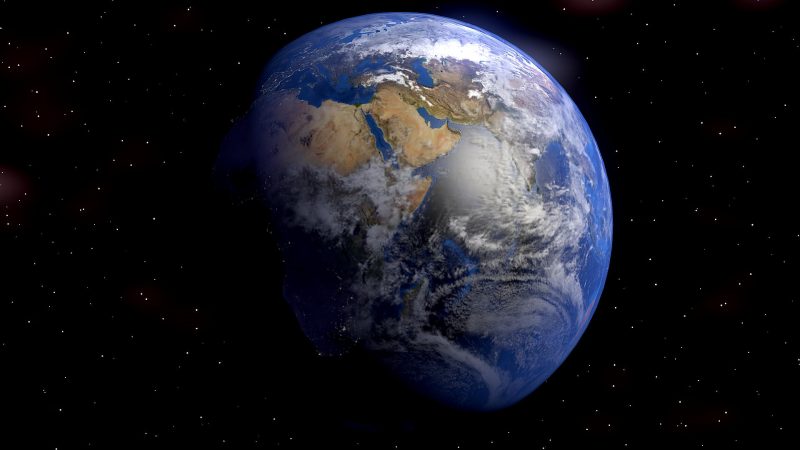
A provocative new theory has sparked interest and debate in the scientific community: Earth's rotation within its geomagnetic field might be harnessed to generate electricity. Although the idea remains contentious, it has attracted considerable attention following a study by researchers at Princeton University, published in Physical Review Research and presented at a meeting of the American Physical Society.
To test their hypothesis, the researchers built a hollow cylindrical device made from a soft magnetic material composed of manganese, zinc, and iron. They observed a tiny voltage of 17 microvolts, which varied depending on the device's orientation relative to Earth's magnetic field. No voltage was detected when a solid conductor was used instead.
The proposed mechanism is analogous to how traditional power plants operate: by moving conductors through a magnetic field to induce electron flow and generate current. As Earth rotates, some components of its magnetic field remain stationary in space, while conductors on Earth's surface move through them. Normally, this motion does not generate current because the movement of electrons induces an opposing electric field that cancels out the effect. However, the researchers found that when certain materials with unique magnetic properties are shaped into cylindrical tubes, they can guide the geomagnetic field into an unusual configuration—one that produces a net electromagnetic force strong enough to generate a small current.
While the results are intriguing, many physicists remain skeptical. The researchers acknowledge that further evidence is needed to confirm that the observed voltage is truly caused by Earth's rotation—such as reproducing the experiment at different latitudes.
Physicists Suggest Earth's Rotation Could Generate Electricity
Tags
A groundbreaking study by scientists from Pennsylvania State University and Columbia University, recently published in Nature Geoscience, reveals that Earth's continents owe their long-term stability—and their role as the cradle…

When earthquakes strike, the ground shaking people feel accounts for only a small fraction of the total energy released. Researchers at the Massachusetts Institute of Technology (MIT) have now shown…

Scientists analyzing satellite data have uncovered a mysterious material disturbance near Earth’s core–mantle boundary that occurred between 2006 and 2008. The anomaly, recently detected by the US–German "Gravity Recovery and…
A groundbreaking study published in Nature Materials suggests that the combination of salt, ice, and mechanical strain could become a key to future renewable energy. Researchers have demonstrated that specially…

How did life arise from nothing? A new mathematical study offers a surprising perspective on this ultimate question. Researchers at Imperial College London suggest that the probability of life naturally…
Despite their simple structure, mosses are capable of surviving in some of Earth's most extreme environments, such as Antarctica, deserts, and high mountains. Now, researchers from Hokkaido University in Japan…