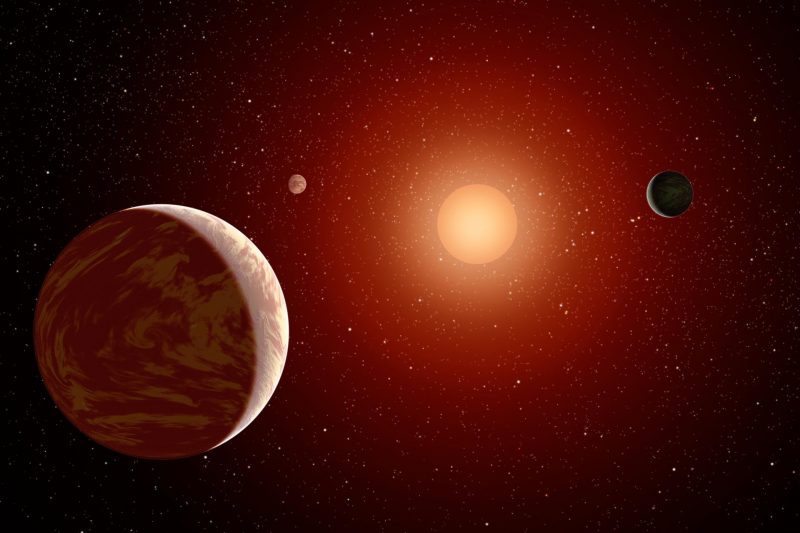
Red dwarf stars are capable of generating stellar flares carrying extremely high levels of far-ultraviolet radiation, surpassing previous estimates significantly. These intense ultraviolet emissions could have a significant impact on the habitability of planets around red dwarf stars. This research, led by astronomers from the Institute for Astronomy at the University of Hawaii, has recently been published in the Monthly Notices of the Royal Astronomical Society.
Previously, few stars were thought to produce enough ultraviolet radiation through flare activity to affect the habitable potential of their surrounding planets. However, the study indicates that more stars may possess this influence.
The research team conducted a search for flares among nearly 300,000 stars using archival data from NASA's Galaxy Evolution Explorer (GALEX), a NASA mission that observed the near-ultraviolet and far-ultraviolet wavelengths across much of the sky from 2003 to 2013. By employing new computational methods, the team derived fresh insights from existing data. They found that ultraviolet radiation from stellar flares could erode planetary atmospheres, threatening their ability to support life; alternatively, these emissions could also foster the formation of RNA building blocks crucial for life.
This study challenges existing models concerning stellar flares and the habitability of exoplanets, revealing that the energy from far-ultraviolet radiation generated by flares is on average three times higher than conventional assumptions, sometimes even reaching up to twelve times the expected levels. However, the specific reasons for this heightened ultraviolet radiation remain unclear and require further research for elucidation.
Ultraviolet Flares from Red Dwarfs Challenge Habitability Models
Tags
At a joint meeting of the European Planetary Science Congress (EPSC) and the Division for Planetary Sciences (DPS) in Helsinki, scientists from the Space Research Institute of the Austrian Academy…
For decades, scientists have been puzzled by a strange solar phenomenon often called “solar rain.” Unlike rainfall on Earth, this occurs in the Sun's corona—a superheated plasma layer above its…
Astronomers have discovered a mysterious new world at the edge of the solar system—a trans-Neptunian object (TNO) designated 2017 OF201. The discovery, made by researchers from the Institute for Advanced…
A new NASA study indicates that Saturn's largest moon, Titan, may host naturally forming primitive cell-like structures called vesicles within its liquid hydrocarbon lakes. The finding offers fresh insight into…
Astronomers may have detected a giant exoplanet orbiting Alpha Centauri A, a Sun-like star located about 4.3 light-years from Earth. The candidate planet lies within the star's habitable zone and…
For the first time, astronomers have observed a planetary system in the earliest known stage of formation outside our solar system—a breakthrough that sheds new light on the origins of…