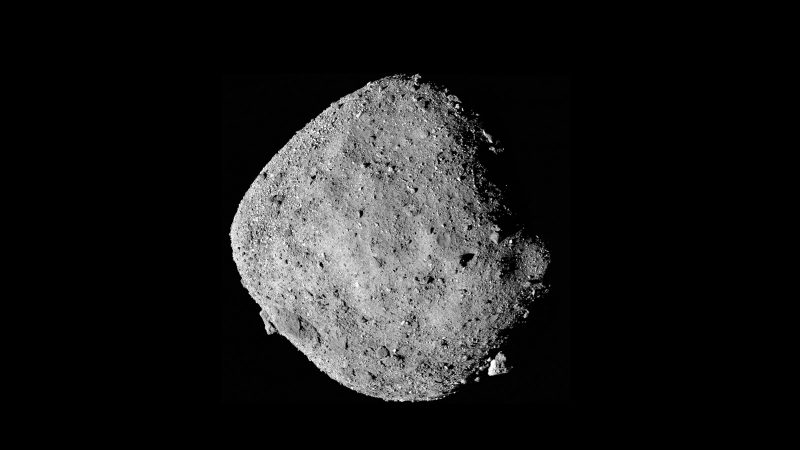
NASA's OSIRIS-REx spacecraft is scheduled to return to Earth on September 24, carrying a sample of an asteroid that poses a potential collision risk to our planet in 159 years. The asteroid, named Bennu, falls under the category of potentially hazardous asteroids due to its intersecting orbit with Earth. Scientists estimate that there is a 0.037% chance, or one in 2,700, of Bennu colliding with Earth on September 24, 2182.
Bennu is a relic from the early stages of our solar system, dating back approximately 4.5 billion years. It features a diamond-shaped body with a diameter of around 500 meters. Researchers believe that studying Bennu can provide valuable insights into the origin of the solar system and life itself.
The OSIRIS-REx mission was launched by NASA in 2016 with the objective of studying and collecting samples from Bennu. In 2020, the spacecraft successfully landed on Bennu's surface and gathered approximately 250 grams of rock material from a site called Nightingale. The collected sample is anticipated to be uncontaminated and hold significant scientific value.
During the mission, NASA made an intriguing discovery concerning Bennu: the asteroid was consistently expelling particles into space. Potential causes for this phenomenon include meteor impacts, thermal stress fractures, and the release of water vapor.
By analyzing the sample obtained from Bennu, NASA aims to enhance our understanding of the asteroid and its potential threat to Earth. Additionally, NASA has contingency plans to either alter Bennu's trajectory or mitigate the threat it poses, if necessary.
NASA OSIRIS-REx Returns: Examining Bennu's Sample and its Implications for Earth's Safety
Tags
When earthquakes strike, the ground shaking people feel accounts for only a small fraction of the total energy released. Researchers at the Massachusetts Institute of Technology (MIT) have now shown…

Scientists analyzing satellite data have uncovered a mysterious material disturbance near Earth’s core–mantle boundary that occurred between 2006 and 2008. The anomaly, recently detected by the US–German "Gravity Recovery and…
A new NASA study indicates that Saturn's largest moon, Titan, may host naturally forming primitive cell-like structures called vesicles within its liquid hydrocarbon lakes. The finding offers fresh insight into…
How did life arise from nothing? A new mathematical study offers a surprising perspective on this ultimate question. Researchers at Imperial College London suggest that the probability of life naturally…
Despite their simple structure, mosses are capable of surviving in some of Earth's most extreme environments, such as Antarctica, deserts, and high mountains. Now, researchers from Hokkaido University in Japan…

A new study reveals that Earth's civil and military radar systems may be inadvertently transmitting signals into space that could be detected by alien civilizations. These unintended electromagnetic emissions—especially from…