A team of international researchers is calling on the United Nations to incorporate Earth’s orbital protection into its Sustainable Development Goals (SDGs). Led by experts from NASA’s Jet Propulsion Laboratory (JPL), the University of Plymouth, and the University of Texas at Austin, the initiative highlights the growing urgency of this issue.
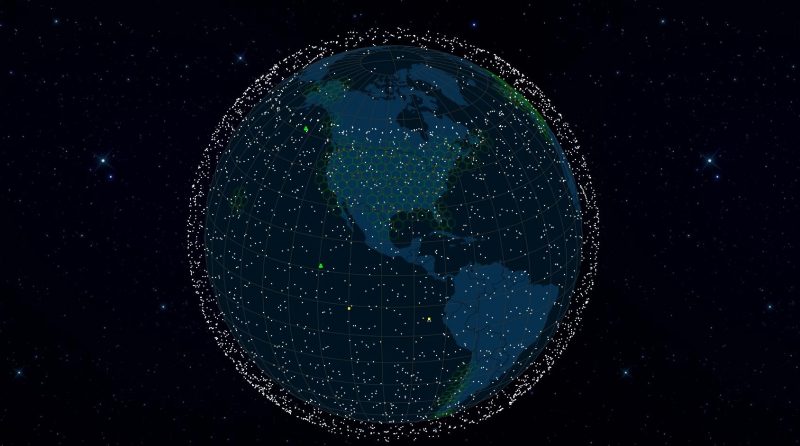
The proliferation of massive satellite constellations, consisting of thousands of small satellites, has significantly increased the number of objects in Earth’s orbit. While these satellites support internet connectivity and Earth monitoring, they also contribute to an exponential rise in orbital congestion. Approximately 15 years ago, fewer than 1,000 satellites were in orbit; today, that number has increased more than tenfold and is expected to continue rising. Once satellites complete their missions, they become hazardous space debris, posing collision risks that generate further debris, exacerbating the space junk problem.
Since the launch of the Soviet Union’s Sputnik satellite nearly 70 years ago, space technology has become an essential component of modern life, underpinning services such as television broadcasting, internet connectivity, and satellite navigation.
The UN’s 2015 Sustainable Development Agenda includes 17 SDGs, addressing global challenges such as hunger, poverty, healthcare, education, gender equality, clean water access, and climate change. The research team argues that incorporating space sustainability into these goals would establish a necessary global framework for addressing orbital protection.
The researchers note that one existing SDG is closely linked to space sustainability. SDG 14 focuses on protecting marine life and addressing oceanic plastic pollution, a challenge that parallels the growing space debris crisis. Lessons learned from marine waste management could provide valuable insights for mitigating the threat of orbital debris.
For years, space sustainability experts have warned that the increasing volume of space junk poses a significant threat to space security. According to the European Space Agency, Earth’s orbit currently contains approximately 40,500 uncontrolled debris pieces larger than 10 cm, 1.1 million fragments measuring 1–10 cm, and up to 130 million pieces smaller than 1 cm. These fragments travel at speeds of around 8 km per second, posing potential hazards to operational satellites and spacecraft. Some experts caution that the onset of the “Kessler Syndrome” may already be underway—a scenario in which uncontrolled collisions generate cascading debris, heightening risks to space operations.
Additionally, atmospheric scientists are raising concerns about the potential environmental impact of satellite reentry. As satellites burn up in Earth’s atmosphere, they release aluminum oxide, a chemical that can deplete atmospheric ozone and alter Earth’s albedo (its ability to reflect sunlight). Some researchers warn that, without effective mitigation measures, pollution from satellite reentry could undermine the achievements of the Montreal Protocol in ozone protection and exacerbate climate change in the coming decades.
Experts Urge Inclusion of Orbital Protection in Sustainable Development Goals
Tags
When earthquakes strike, the ground shaking people feel accounts for only a small fraction of the total energy released. Researchers at the Massachusetts Institute of Technology (MIT) have now shown…

Scientists analyzing satellite data have uncovered a mysterious material disturbance near Earth’s core–mantle boundary that occurred between 2006 and 2008. The anomaly, recently detected by the US–German "Gravity Recovery and…
Astronomers have discovered a mysterious new world at the edge of the solar system—a trans-Neptunian object (TNO) designated 2017 OF201. The discovery, made by researchers from the Institute for Advanced…
How did life arise from nothing? A new mathematical study offers a surprising perspective on this ultimate question. Researchers at Imperial College London suggest that the probability of life naturally…

Despite their simple structure, mosses are capable of surviving in some of Earth's most extreme environments, such as Antarctica, deserts, and high mountains. Now, researchers from Hokkaido University in Japan…

A new study reveals that Earth's civil and military radar systems may be inadvertently transmitting signals into space that could be detected by alien civilizations. These unintended electromagnetic emissions—especially from…