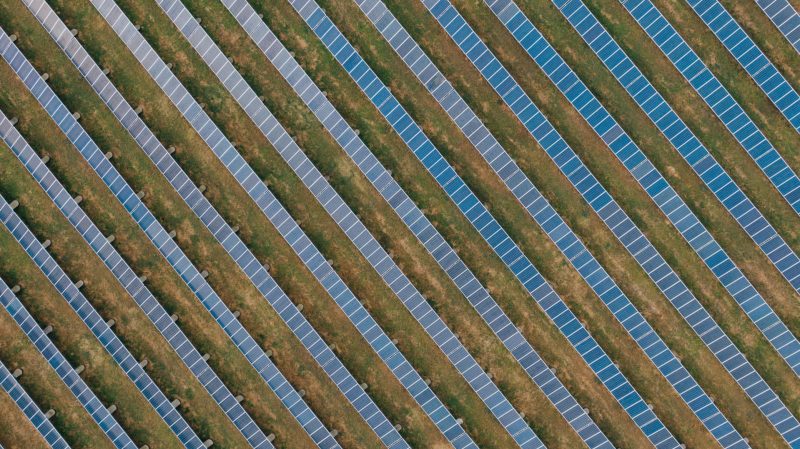
A new study from Michigan State University suggests that integrating solar panel arrays into farmland—while continuing crop production—may be more economically beneficial than dedicating land solely to agriculture or solar energy.
By analyzing 25 years of remote sensing data and agricultural revenue from California, researchers found that farmers who installed solar panels on low-yield farmland achieved greater economic stability per unit area compared to those who relied entirely on crops or converted their land exclusively to solar energy. Published in Nature Sustainability, the study offers a promising alternative for farmers under economic pressure.
California, a leader in both agricultural output and solar energy development, faces mounting challenges from extreme weather and resource competition. In response, some farmers are adopting a "co-location" model—strategically integrating solar infrastructure into active farmland to balance energy generation and food production.
The research team estimated that if all land currently used for solar installations were instead farmed, it could feed an additional 86,000 people. However, the co-location model allows farmers to reduce inputs like water and fertilizer while generating electricity revenue, helping to offset potential crop yield reductions. Solar arrays may also lower irrigation needs, easing local water stress.
Dual Land Use: Solar Panels and Crops Together May Offer Optimal Farm Profits
Tags
For decades, scientists have been puzzled by a strange solar phenomenon often called “solar rain.” Unlike rainfall on Earth, this occurs in the Sun's corona—a superheated plasma layer above its…

Tens of millions of years before humans developed agriculture, termites had already evolved advanced farming systems—cultivating fungi inside their nests as a primary food source. Much like human farmers, these…

When earthquakes strike, the ground shaking people feel accounts for only a small fraction of the total energy released. Researchers at the Massachusetts Institute of Technology (MIT) have now shown…

A groundbreaking study published in Nature Materials suggests that the combination of salt, ice, and mechanical strain could become a key to future renewable energy. Researchers have demonstrated that specially…

A chemistry team at the University at Albany has successfully synthesized manganese diboride (MnB₂), a high-energy compound that could serve as a next-generation rocket fuel, significantly improving the efficiency of…

Astronomers have discovered a mysterious new world at the edge of the solar system—a trans-Neptunian object (TNO) designated 2017 OF201. The discovery, made by researchers from the Institute for Advanced…