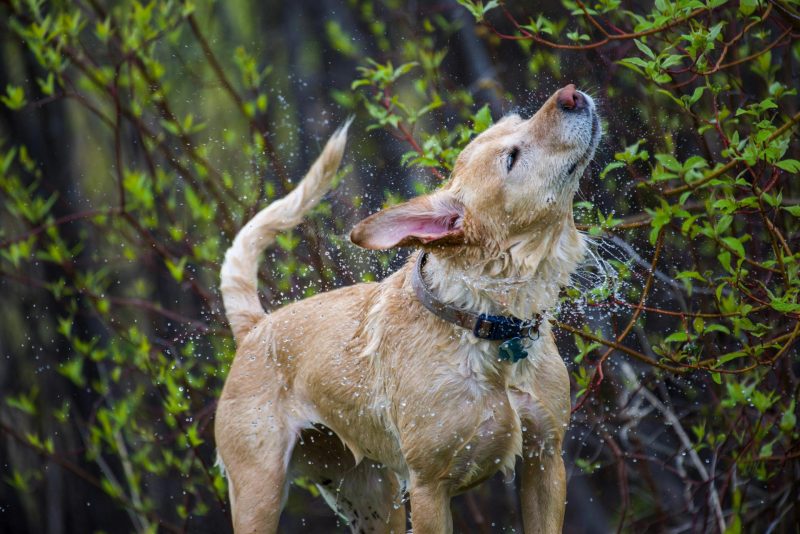
When a dog shakes off water from its fur, this action is not random or meant to intentionally wet those nearby. Many furry mammals exhibit this instinctive reflex, including rodents, cats, squirrels, lions, tigers, and bears. Researchers at Harvard University in the United States have now identified the neural circuitry that triggers the typical "wet dog" shaking behavior in mice, involving a special type of tactile sensor called "C-Low Threshold Mechanoreceptor (C-LTMR)" and neurons that connect the spinal cord to the brain. These findings were published in the latest issue of the journal Science.
In humans, tactile sensors are associated with pleasurable sensations, such as gentle hugs or soft touches. However, in mice and other animals, they serve a protective role: alerting the skin to the presence of foreign objects, whether water, dust, or parasites. Researchers state that when these stimuli cause hair bending on the skin, it activates C-LTMR, "making the skin's sensitivity extend beyond the surface".
Researchers also studied how signals from C-LTMR coordinate the shaking behavior of a wet dog through the nervous system. They traced a group of neurons in the spinal cord that connect to the periaqueductal gray region in the brain, which is involved in processing pain, temperature, and touch.
Neuroscientists suggest that the shaking behavior of a wet dog is a highly coordinated motor response, providing a solid starting point for exploring how the brain commands and controls movements.
Tags
A study published in Nature has uncovered a new mechanism for how the brain stores emotional memories—one that centers not on neurons, but on astrocytes, the star-shaped glial cells once…

For years, biochar was seen mainly as a passive material—removing contaminants from water by adsorption or serving as a support for catalysts. However, new research has revealed that biochar itself…

When people experience striking events, not only do those moments become etched in memory, but even seemingly ordinary experiences that occurred shortly before can become unusually vivid. The neural mechanism…

People with attention-deficit/hyperactivity disorder (ADHD) may possess an often-overlooked strength: excessive curiosity. While typically associated with distractibility and hyperactivity, this trait is also closely linked to creativity, adaptability, and a…

Are colors perceived the same way by everyone? A new neuroscience study suggests that, at least on the neural level, the answer may be yes. The question of whether color perception…

For decades, neuroscientists believed that when a person loses a limb, the brain's corresponding sensory region would be “taken over” by neighboring body parts—a process known as cortical reorganization. However,…