Following its departure from the EU, the UK has chosen not to participate in the International Thermonuclear Experimental Reactor (ITER) project. Instead, the British government has declined the invitation to become a formal member of ITER and intends to concentrate on its own nuclear fusion research, both in the public and private sectors.
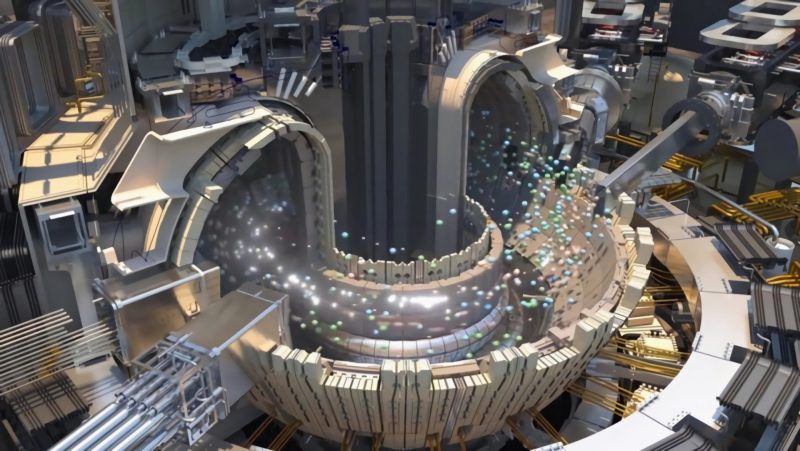
ITER is presently one of the largest international scientific research collaborations globally, funded by major international groups including the United States, India, Japan, China, Russia, South Korea, and the European Union. Despite several delays, ITER is currently under construction in France and is expected to be completed by 2025.
Since Brexit, the UK has been excluded from various international cooperation initiatives. However, negotiations with the EU may allow the UK to rejoin the Horizon Europe and Copernicus projects this year, though it has stated that it will not rejoin Euratom.
During a recent celebration of the Joint European Toroidal Reactor (JET) results in the UK, Elena Righi, head of research at the European Atomic Community, urged the UK to formally rejoin the ITER project.
The European Council strongly encourages the UK to participate in ITER and the other three major nuclear fusion research projects of the European Atomic Community in the next research phase starting in 2028. This would facilitate the UK Atomic Energy Authority's (UKAEA) involvement in the European Fusion R&D Innovation Alliance (EUROfusion), allowing the UK to contribute more significantly to the construction and operation of ITER.
Nevertheless, the UK government remains steadfast in its decision not to join the ITER project. It believes that private sector investment in fusion research will lead to more efficient and cost-effective commercial reactors. This decision will enable the UK to save £650 million, which can be allocated to both private and public research. However, UK authorities have expressed openness to exploring alternative avenues of cooperation with the ITER plan, such as personnel exchanges.
The UK is actively developing the Fusion Spherical Tokamak (STEP) program for energy production, with the goal of commercializing fusion energy by 2040.
UK Pursues Independent Nuclear Fusion Research, Declines ITER Membership
Tags
Physicists have now demonstrated all the crucial components that make up a nuclear clock—a device that tells time by measuring tiny energy changes within atomic nuclei. Such a clock could…

The European Commission has recently announced that South Korea will be joining the "Horizon Europe" plan, marking the first participation of an East Asian country in the EU's prestigious scientific…

The European Commission has announced that starting from 2024, USB-C will become the standard charging port for electronic devices in the EU. This move aims to establish a universal charging…

According to a statement by Apple CEO Tim Cook to BBC News, Apple has expressed its intention to expand its workforce in artificial intelligence in the UK. Cook reiterated that Apple…

Microsoft has recently posted a job opening seeking a nuclear technology expert. The company aims to evaluate and integrate small modular nuclear reactors and micro-reactors to generate energy for its…