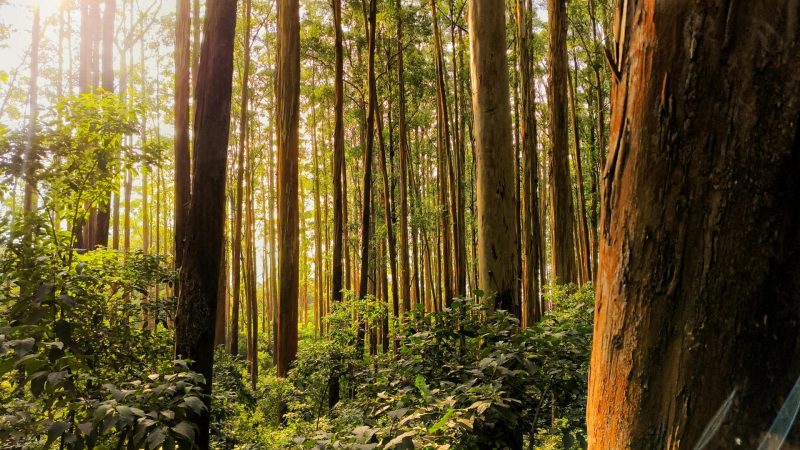
In the Western Ghats of India, researchers are scaling towering trees and installing sensors on their leaves to investigate how tropical forests are responding to global warming. This pioneering study provides the first detailed analysis of cumulative heat exposure in tropical trees—and the findings suggest that these trees may be more resilient than previously believed.
Summer temperatures in the region often exceed 37°C and are projected to rise by another 4°C over the next 60 years. Leaf temperatures typically surpass ambient air temperatures, and when they exceed 46.7°C, photosynthesis shuts down, depriving trees of essential energy. Many tropical tree species have already experienced such extreme temperatures.
However, the study revealed that the duration of high-temperature exposure plays a more critical role than the peak temperature itself. Researchers monitored the leaves of 12 different tree species over four months in a six-hectare plantation. Despite frequent sensor losses due to strong winds and wildlife interference, the data showed that daily leaf temperatures exceeded the critical threshold for less than 10 minutes on average.
Laboratory analyses indicated that the critical temperature threshold for local trees ranges from 43.4°C to 45.5°C—slightly below the global average. Although exposure beyond this range for 30 minutes can cause irreversible damage to leaves, the actual exposure time was relatively brief, suggesting that photosynthetic efficiency remains largely unaffected.
This study offers valuable insights into how tropical forests may adapt to climate change. Despite the logistical challenges of fieldwork, scientists hope to expand the use of temperature sensors in ecosystems around the world to better understand the impact of heat stress on trees. The research not only contributes to forest conservation efforts but also offers a fresh perspective on global warming resilience.
Tropical Trees May Be More Heat-Resilient Than Expected, New Study Finds
Tags
A rare mineral found in meteorites and on Mars has drawn scientific interest for its unusual thermal behavior. Unlike typical materials, this substance maintains nearly constant thermal conductivity across temperature…

Earth's climate has swung dramatically between extremes of ice and heat throughout its history. In fact, for much of geological time, Earth has been a warm, ice-free planet. During the Cretaceous…

MIT Boosts Key Photosynthesis Enzyme Efficiency by 25%, Paving Way for Higher Crop Yields
A research team at the Massachusetts Institute of Technology (MIT) has significantly enhanced the efficiency of Rubisco, a crucial enzyme in photosynthesis, using an advanced technique known as continuous directed…
New Molecular Magnet Sets Record for High-Density Data Storage at Elevated Cryogenic Temperatures
A research team from the University of Manchester and the Australian National University has developed a novel molecular magnet capable of storing data at the ultra-low temperature of 100 Kelvin…

In recent weeks, extreme heatwaves have grippedd the United States, China, and Europe. Yet scientists warn that persistent high temperatures—even those not meeting official heatwave criteria—can also pose serious health…

Global warming could significantly increase methane emissions from wetlands by promoting the growth of methane-producing microbes while suppressing the activity of methane-consuming organisms, according to a study published in Science…