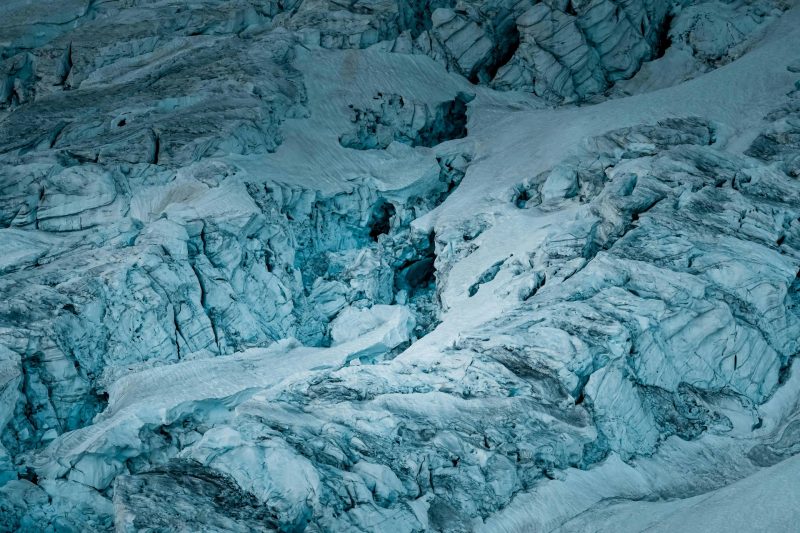
Climate change is not only intensifying droughts, heatwaves, and storm surges but may also be increasing the risk of earthquakes through accelerated glacier melt. A research team from ETH Zurich has found that the 2015 heatwave led to rapid glacial retreat on Grandes Jorasses—a peak in the Mont Blanc massif—causing meltwater to seep underground and coincide with a cluster of minor seismic events. Although these tremors caused no direct damage, the study suggests that an increase in small quakes could elevate the probability of larger earthquakes.
It is already well established that when water infiltrates rock pores under high pressure, it can reduce fault stability and potentially trigger earthquakes—a mechanism observed in eastern Taiwan and in industrial activities like shale gas extraction and wastewater injection. Now, with global warming accelerating glacial melt, more water is entering subsurface fault systems, potentially compounding seismic risks. Researchers at Pusan National University in South Korea note that while direct evidence has been scarce, this new study offers multidimensional data indicating the Earth's geological systems are responding to climate shifts.
In the Mont Blanc region, seismic activity shows a seasonal pattern, peaking in late summer as meltwater infiltrates the ground and dipping in early spring. However, since 2015, both the frequency and magnitude of earthquakes have risen significantly, correlating with the severity of heatwaves. Shallow quakes lag behind peak heatwaves by about a year, while deeper quakes show a two-year delay—possibly due to meltwater percolating through mountain fault networks and pushing more faults toward rupture thresholds.
While earthquakes in the Alps typically do not exceed magnitude 6 and existing infrastructure is generally resilient, the findings raise concerns for seismically active glacier-covered regions such as the Himalayas. Researchers at the University of Montpellier caution that more data is needed to confirm the climate-seismic link, but the broader consequences of glacier retreat could be far greater than previously anticipated. As climate change continues, feedback mechanisms within Earth's geology may pose unforeseen challenges.
Melting Glaciers May Trigger Earthquakes as Climate Change Alters Tectonic Stability
Tags
Scientists have discovered hundreds of massive coral boulders scattered inland on Anegada Island in the British Virgin Islands—evidence of a catastrophic tsunami that struck in the late 14th century. The…
The Sahara Desert, one of the driest places on Earth with an average annual rainfall of just about three inches, may experience a striking transformation later this century. A new study…
A new study led by the University of Exeter warns that the world has crossed its first recognized climate "tipping point", as coral reef ecosystems enter a state of widespread…
When earthquakes strike, the ground shaking people feel accounts for only a small fraction of the total energy released. Researchers at the Massachusetts Institute of Technology (MIT) have now shown…
A new study led by the University of Reading challenges long-held assumptions about primate origins. For decades, scientists believed primates, including humans, emerged from warm, humid tropical forests. However, reanalysis…
A research team from The Hong Kong Polytechnic University has, for the first time, used Satellite Laser Ranging (SLR) technology to generate precise global records of ocean mass changes spanning…