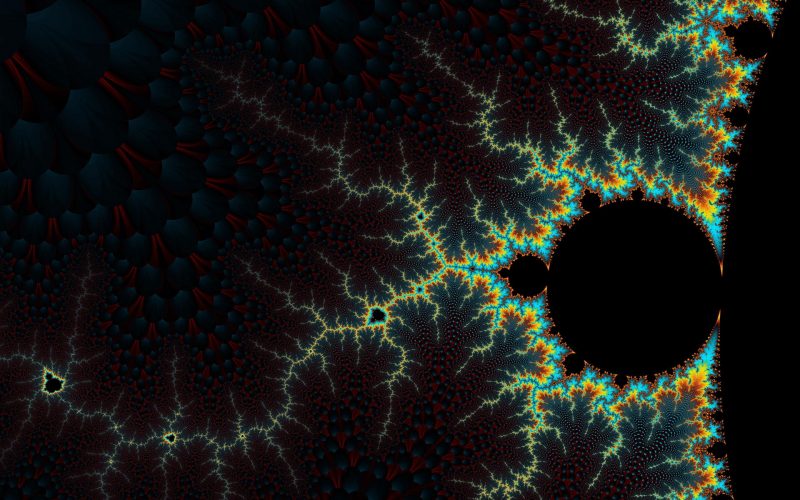
Fifty years ago, the concept of the fractal was formally introduced as a mathematical model for describing irregular, fragmented shapes, breaking free from the constraints of classical Euclidean geometry. It offered scientists a new language to understand the intricate patterns of nature.
At the heart of fractal geometry lies self-similarity—structures that, regardless of scale, repeat their patterns in miniature. This property is widely observed in nature: the edges of clouds, mountain ridges, blood vessels, and lung structures all display such recursive forms. Unlike idealized mathematical fractals, however, natural fractals are approximate and break down at the molecular or atomic level. Unlike traditional geometry that relies on integer dimensions, fractals are characterized by fractional dimensions, which quantify complexity and roughness. For example, the Koch snowflake has a dimension of about 1.26, while the endlessly winding coastline approaches 2.
Fractal theory soon expanded far beyond pure mathematics. It has become essential in fields ranging from geography and physics to biomedical science, helping explain phenomena such as how fractal vascular networks optimize both blood flow and oxygen delivery. Mathematicians have also explored profound connections between fractals and the famed Riemann Hypothesis, hinting at possible insights into this long-standing problem.
Fractals have also driven technological innovation. Microsoft and others adopted fractal-based image compression algorithms, which reduced storage needs through multi-scale encoding. In telecommunications, fractal antennas exploit space-filling properties to enable multi-band communication in compact designs, now standard in mobile devices and satellites.
More recently, fractal theory has begun to influence artificial intelligence research. Some scholars argue that the brain's neural networks exhibit fractal-like organization, where self-similar connectivity underpins efficient information processing. Emulating such architectures may prove vital for advancing neuromorphic computing and even the pursuit of artificial consciousness.
Fractals at Fifty: From Nature's Geometry to AI Inspiration
Tags
With the rapid advancement of large language models, today's most sophisticated artificial intelligence (AI) systems can easily pass the classic Turing Test. This has prompted scientists to reconsider whether new…
Artificial intelligence (AI) is rapidly transforming scientific research. Once limited to analyzing data, AI systems are now able to design experiments and even generate new hypotheses. Some experts believe that,…
According to WIRED, OpenAI is preparing to launch a standalone social app built around its AI video generation model, Sora 2. The app closely mirrors the design and user experience…
Artificial intelligence (AI) is increasingly helping scientists decode how animals communicate and explore the possibility of dialogue across species. Recent studies show that species such as bonobos, chimpanzees, Japanese tits,…
Artificial intelligence (AI) is increasingly accelerating research across multiple disciplines worldwide, particularly in automating the generation of scientific hypotheses. By scanning vast amounts of literature, AI can identify research gaps…

Advances in dataset optimization, computing power, and algorithms have significantly boosted the accuracy of artificial intelligence (AI)-based facial recognition, with most systems now surpassing 99% accuracy in controlled environments and…