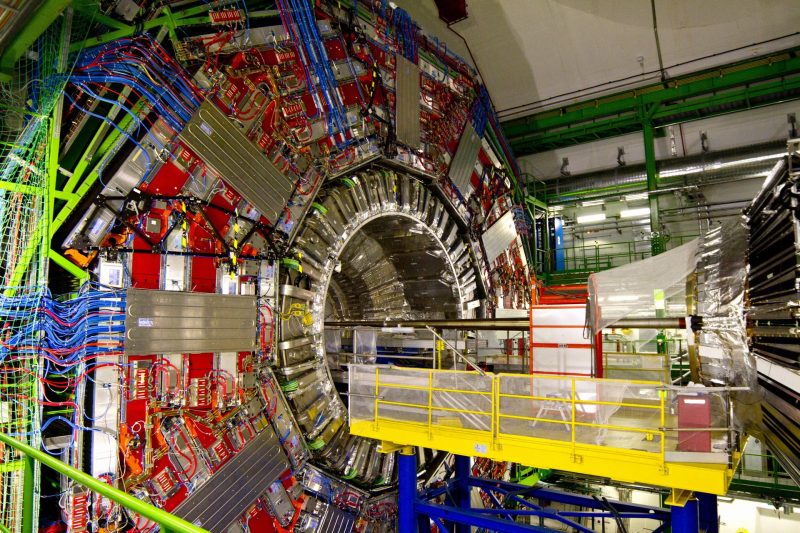
Europe is making strides in the implementation of a $17 billion project for the construction of the Future Circular Collider (FCC), a 91-kilometer particle accelerator situated beneath the French and Swiss countryside. The objective of this ambitious plan is to facilitate in-depth research on the Higgs boson.
However, as per a report from "Nature," scientists are facing significant pressure to justify the construction of a supercollider due to the limited new physics discoveries at the presently operating 27-kilometer Large Hadron Collider (LHC) near Geneva, Switzerland. They must convince funders that the substantial investment is worthwhile.
Preliminary information regarding the plan has been obtained from an interim report by the European Organization for Nuclear Research (CERN), which is assessing the feasibility of the FCC. Although the report has not yet been made public, it is certain that the FCC will surpass its predecessor, the 27-kilometer LHC, in size and capabilities.
It has been suggested that construction of the FCC could commence as early as 2033, involving the excavation of a 91-kilometer circular tunnel positioned 200 meters underground, encompassing an area larger than that of Chicago in the United States. The proposed design entails dividing this tunnel into four experimental halls.
Fabiola Gianotti, the Director General of CERN, stressed that a significant portion of the FCC construction budget will be covered by the existing CERN funding. However, the program still requires financial support from full CERN member states and associate members, including the United States and Japan. The report, unfortunately, does not provide specific cost details.
Some scientists have expressed opposition to the plan, arguing that the expenses associated with building such a colossal collider outweigh the potential benefits, particularly when the theoretical framework does not offer clear indications of what novel discoveries may be made.
The complete research report on the plan is expected to be released next year, with relevant authorities anticipated to make a decision regarding plan approval before 2028.
Europe Advances $17 Billion Supercollider Plan to Study Higgs Boson
Tags
Chinese tech giant ByteDance is strategically positioning itself in the European artificial intelligence landscape with plans to establish a cutting-edge research and development center on the continent. According to a report…

A research team led by the University of Barcelona in Spain has provided new insights into the emergence and development of early Neolithic agriculture in Western Europe. They have discovered…

The European Commission has recently announced that South Korea will be joining the "Horizon Europe" plan, marking the first participation of an East Asian country in the EU's prestigious scientific…

The recent implementation of a 15-day visa-free travel policy for visitors from six European countries to China has sparked a significant surge in interest in traveling to the Asian nation. According…

The European Space Agency's Science Program Committee has recently given its approval for the laser interferometer space antenna project. This groundbreaking initiative aims to detect gravitational waves resulting from collisions…