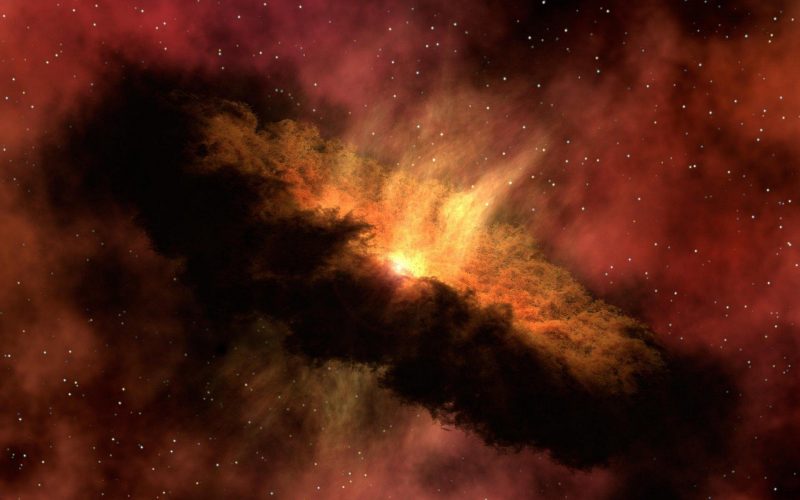
A groundbreaking discovery suggests that the first generation of stars in the universe may have produced significant amounts of water upon their death, challenging previous assumptions about the timeline of water’s existence in the cosmos. Scientists had long believed that water only began to appear around 780 million years after the Big Bang. However, a new study indicates that water could have emerged as early as 100 to 200 million years post-Big Bang.
This research, conducted by a team from the University of Portsmouth in the UK, was recently published in Nature Astronomy. Using advanced computer simulations, the scientists modeled the life and death cycles of two first-generation stars. Their findings reveal that during supernova explosions, expelled material created conditions where hydrogen and oxygen could react within the expanding remnants, forming water vapor.
The process was slow due to the low atomic density in the outer regions of supernova remnants. However, over millions to tens of millions of years, the central dust cores of these remnants cooled sufficiently for water to accumulate. Simulations suggest that smaller supernovae could generate water equivalent to one-third of Earth’s total mass, while larger ones might produce water masses equivalent to 330 Earths.
Although the total water mass produced was relatively small, researchers note that it became highly concentrated in the dense cores of supernova remnants—regions that could later give birth to new stars and planets. If a planet were to form within such a core from a large supernova, it could potentially become a "water world."
While the presence of water alone does not imply the existence of life, this discovery suggests that the conditions necessary for life may have emerged much earlier in the universe than previously thought. It offers new perspectives on the origins of life and the potential for habitable environments throughout the cosmos.
Early Universe Water: How the First Stars May Have Produced Vast Amounts of Water
Tags
For years, biochar was seen mainly as a passive material—removing contaminants from water by adsorption or serving as a support for catalysts. However, new research has revealed that biochar itself…
Astronomers studying the unusual supernova SN2021yfj have gained rare insights into the internal structure of a massive star, challenging conventional theories of stellar death. The discovery, led by an international…
For years, dark streaks observed on the surface of Mars were thought to be potential evidence of liquid water, sparking discussions about the planet's habitability. However, a new study suggests…
Researchers have developed a novel sponge-like device that can extract moisture from the air and release it into a container using solar energy. Unlike traditional fog-harvesting or radiative cooling techniques,…

A groundbreaking study published in Science reveals that terrestrial water storage—comprising groundwater, soil moisture, and surface water—has been declining at an alarming rate since the start of the 21st century,…

When two materials come into contact, surface charge transfer can occur—like the static electricity generated when a balloon is rubbed against skin. Similarly, water flowing across certain surfaces can gain…