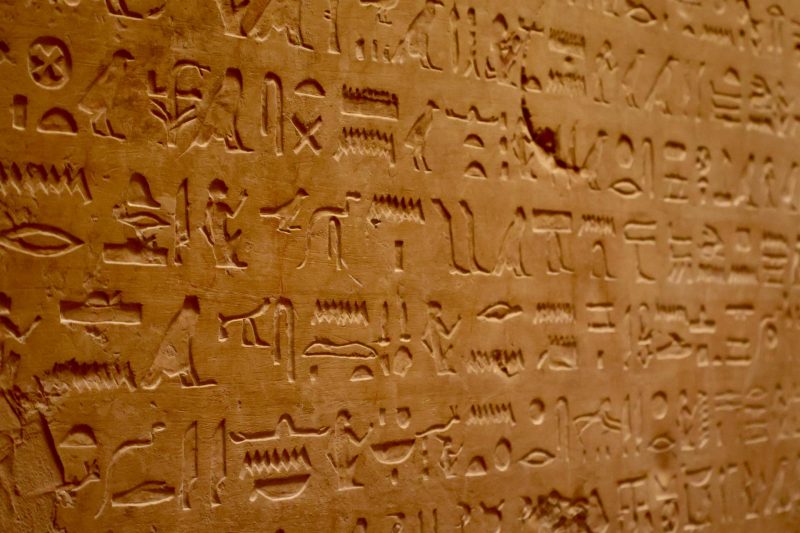
Artificial Intelligence (AI) has profoundly transformed various aspects of modern life and is now poised to reshape our understanding of the ancient world. For instance, artificial neural networks are being employed to interpret ancient texts, ranging from classical texts in Greek and Latin to Chinese oracle bones inscribed on ox bones and turtle shells. They are deciphering vast archives that are unreadable by humans, filling in missing and illegible characters, and decoding rare and vanished languages with almost no trace.
This development promises to bring forth a wealth of new texts, providing scholars with more data than has been available for centuries. However, this is just the beginning. AI tools can identify a greater number of languages, store more information than any individual, and find statistical patterns within texts on their own. These technologies hold the potential to offer a completely new way to explore ancient resources. This not only changes "the questions we want to answer, but the questions we can ask."
Neural networks are composed of layers of interconnected nodes, particularly "deep" neural networks with multiple inner layers. Inspired by visual neuroscience, models known as Convolutional Neural Networks (CNNs) can capture grid-like data from images. They have been used for optical character recognition, but also have other applications: a team studying Chinese oracle bones uses this model to restore eroded letter images. Meanwhile, Recurrent Neural Networks (RNNs), designed to handle data sequences of linear order, are showing great potential in searching, translating, and filling in blank spaces in transcribed ancient texts. For instance, they are used to identify missing characters in hundreds of formulaic administrative and legal texts from ancient Babylon.
Neural networks can transcend and expedite laborious tasks, establishing connections beyond the reach of human experts. This significant leap may pave new pathways for utilizing artificial intelligence to comprehend the ancient world. By delving into unprecedentedly vast digitized text archives, researchers can not only study individual texts more effectively but also pose broader questions about the societies that produced these texts.
Artificial Intelligence Revolutionizing the Study of Ancient Texts
Tags
With the rapid advancement of large language models, today's most sophisticated artificial intelligence (AI) systems can easily pass the classic Turing Test. This has prompted scientists to reconsider whether new…

Artificial intelligence (AI) is rapidly transforming scientific research. Once limited to analyzing data, AI systems are now able to design experiments and even generate new hypotheses. Some experts believe that,…

According to WIRED, OpenAI is preparing to launch a standalone social app built around its AI video generation model, Sora 2. The app closely mirrors the design and user experience…

Artificial intelligence (AI) is increasingly helping scientists decode how animals communicate and explore the possibility of dialogue across species. Recent studies show that species such as bonobos, chimpanzees, Japanese tits,…

Archaeologists have uncovered stone tools at the Little Paxton site, about 80 kilometers east of London, dating back roughly 440,000 years. Using advanced infrared radiofluorescence dating, researchers confirmed the artifacts…

Artificial intelligence (AI) is increasingly accelerating research across multiple disciplines worldwide, particularly in automating the generation of scientific hypotheses. By scanning vast amounts of literature, AI can identify research gaps…