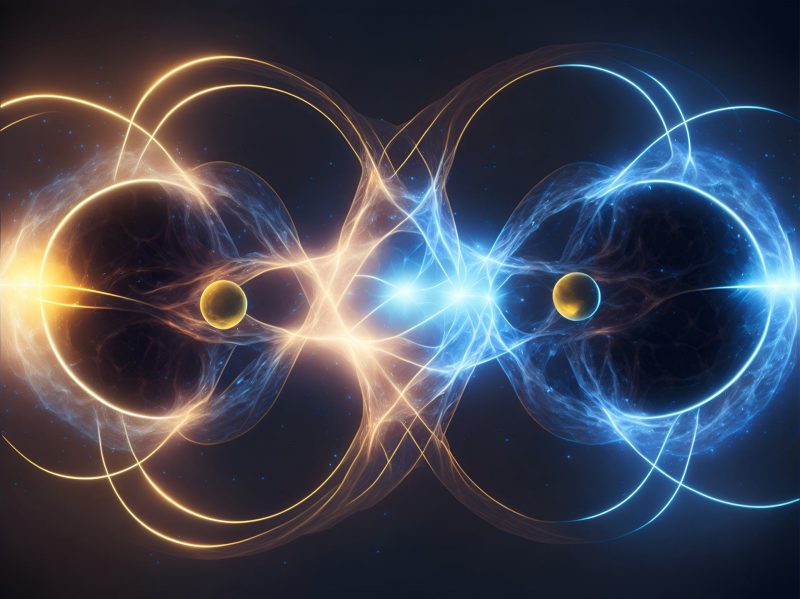
An international research team led by the University of Queensland, Australia, and the German National Metrology Institute (PTB) has developed a groundbreaking method to study dark matter—a mysterious substance believed to hold galaxies together. By leveraging atomic clocks and ultra-stable lasers, the researchers detect hidden dark matter waves through subtle changes in time measurement. Their findings were published in Physical Review Letters, opening new doors to fundamental physics discoveries.
Unlike conventional approaches, the team analyzed data from a network of ultra-stable lasers connected via optical fibers, as well as two atomic clocks aboard GPS satellites. Given its extremely low mass, dark matter behaves like a wave in this context. By using spatially separated clocks, they attempted to measure variations in the wave, which manifest as discrepancies in timekeeping—either clocks ticking at different rates or displaying different times. The greater the distance between clocks, the stronger the effect.
This innovative technique enables researchers to search for previously undetectable forms of dark matter, which neither emit light nor energy and remain invisible to traditional detection methods. By comparing precise measurements across vast distances, the team identified subtle oscillatory effects of dark matter fields—effects that would otherwise cancel out in conventional experiments. Notably, they were able to probe dark matter models that interact universally with all atoms, a challenge for traditional experiments.
This study brings scientists closer to understanding one of the universe’s most elusive and fundamental components. With this approach, researchers can now explore a broader range of dark matter scenarios and potentially answer fundamental questions about the structure of the cosmos.
A Novel Approach to Detecting Dark Matter Using Atomic Clocks and Laser Networks

Tags
A mysterious gamma-ray glow at the center of the Milky Way — puzzling scientists for decades—may finally offer the first observational evidence of dark matter. The finding, based on a…
A new study suggests that supermassive black holes could function as natural particle colliders, potentially offering a novel path to detect dark matter and other unknown particles. This discovery may…
Scientists hypothesize the existence of an ancient type of black hole that could be deeply embedded in the cosmos, invisible and challenging to detect, yet profoundly influential on the evolution…
Physicists have now demonstrated all the crucial components that make up a nuclear clock—a device that tells time by measuring tiny energy changes within atomic nuclei. Such a clock could…

Researchers at the Joint Institute of Laboratory Astrophysics (JILA) have made significant advancements in atomic clock technology, resulting in the creation of a clock that surpasses all previous models in…