Absolute zero is the lowest temperature achievable in this universe. As we continue to lower temperatures, weaker interactions gradually come into play, revealing many fascinating phenomena such as superconductivity. Although the temperature of the entire universe has cooled to only 2.7K (approximately -270.15°C or -454.27°F), we experience the warmth of the sun on Earth, indicating high temperatures. To explore various exotic effects at low temperatures and harness them on Earth, it is necessary to artificially create stable low-temperature environments.
On the path to obtaining low temperatures, there is a familiar pioneer: Faraday. Yes, it is the same Faraday who discovered electromagnetic induction. While studying the chemical properties of chlorine gas, he accidentally obtained liquid chlorine and concluded that it was caused by low temperatures and high pressures. From then on, he relentlessly liquefied almost all known gases of that time, except for oxygen, nitrogen, hydrogen, and other gases, which he deemed "permanent gases." Later facts proved him wrong, but gas liquefaction was just his sideline.
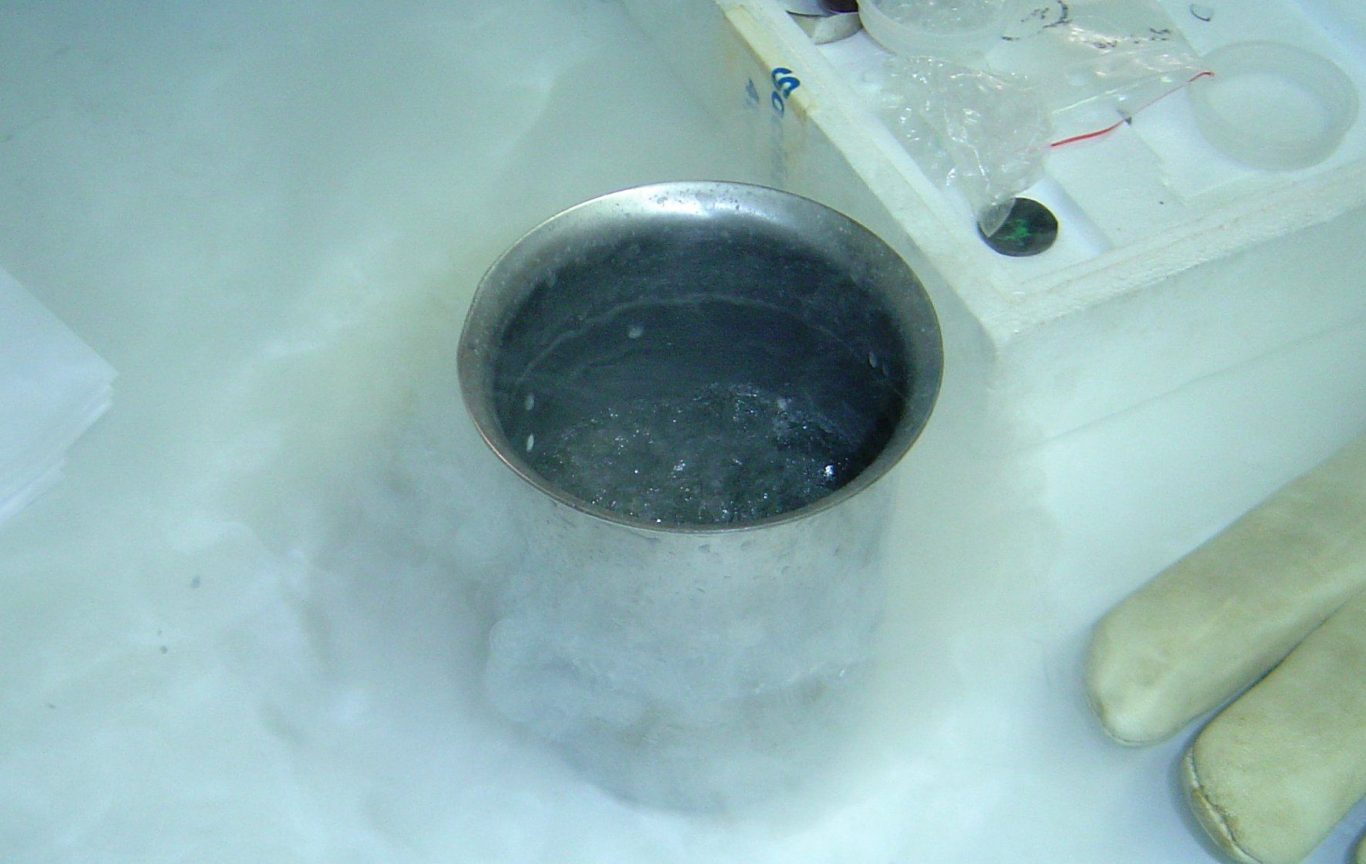 Image Credit: Wikipedia/Liquid nitrogen
Next, the Frenchman Cailletet liquefied oxygen and nitrogen, utilizing an important effect known as the Joule-Thomson effect. In modern dilution refrigerators, there is a crucial component called the "Joule-Thomson heat exchanger," which plays a significant role in liquefying helium gas. Liquefaction of nitrogen pushed the lower temperature limit to -196°C (-320.8°F or 77K).
However, the most significant figure in this field is Dewar. The current low-temperature storage container is named after him. Dewar's important contribution was the liquefaction of hydrogen gas using a stepwise cooling method. The process involved liquefying easily liquefiable gases, followed by throttling expansion for further temperature reduction, and then introducing another gas that was more challenging to liquefy, repeating this process sequentially. Using this extraordinary method, he ultimately achieved a temperature of -260°C (-436°F or 13K). Dewar's aspiration was to conquer the last "permanent gas," helium, but unfortunately, this gas was too scarce, and he could never gather enough of it to fulfill his wish.
 Image Credit: Timeboil
Taking up this challenge was Onnes, who was the head of the physics laboratory at Leiden University in the Netherlands at that time. Under his leadership, they rapidly expanded Dewar's stepwise cooling technology and, with the support of financial resources, established large-scale liquefaction plants. By utilizing the Hampson-Linde cycle, low-temperature Dewar, and Joule-Thomson effect, they successfully liquefied helium gas, pushing the temperature limit further to -269°C (-452.2°F or 4K). Later, with the development of adiabatic demagnetization techniques, they further advanced to 1.5K (-271.65°C or -456.97°F). Onnes also earned the title of "Mr. Absolute Zero" for this achievement. With the aid of liquid helium, Onnes also made the first discovery of superconductivity, which is another remarkable story. After the maturity of helium liquefaction technology, liquid helium became one of the most widely used cryogenic liquids due to its low temperature, inertness, non-toxicity, and safety compared to liquid hydrogen.
However, there is still a considerable distance to go before reaching absolute zero at 1.5K (−271.65°C or −456.07°F), and the journey to reach absolute zero is far from over. There is another isotope of helium called helium-3 (3He). It is a substance that will never solidify under normal pressure. By reducing the pressure and cooling helium-3, it is theoretically possible to approach temperatures close to absolute zero. However, it requires extremely high pumping speeds, making it technically unfeasible.
Later on, scientists discovered that helium-3 can dissolve in helium-4 to form a solution. When the temperature drops below approximately 0.8K (−272.35°C or −458.23°F), a phase transition occurs, resulting in the formation of a concentrated phase and a dilute phase. When helium-3 atoms cross the interface of the phase separation, they carry away some heat. This has become the foundation of the most important technology for achieving ultra-low temperatures in solids, known as the dilution refrigeration technique. Since even at absolute zero, there is still about 6% helium-3 in the dilute phase, the cooling process can continue until very close to absolute zero. Dilution refrigeration can lower the temperature to a few millikelvins (mK), which is only a fraction above absolute zero, just a few hundredths of a degree above zero Kelvin (−273.15°C or −459.67°F).
Furthermore, there is a technique called nuclear adiabatic demagnetization, which can lower the temperature below 1mK (−272.15°C or −457.87°F). At this point, the technology for solid-state cooling is essentially limited. However, by using laser cooling on a small cluster of atomic gases, it is possible to lower the gas temperature to the microkelvin (μK) range.
In August 2018, the QUANTUS Team in Germany achieved a record-breaking man-made temperature of 38 picokelvins above absolute zero (-273.149999999962°C or -459.6699999999296°F). Using a special technique, they cooled rubidium atoms to a state called a Bose-Einstein condensate and created a microgravity environment to further reduce the atoms' energy.
The Journey to Absolute Zero and the Pioneers of Low-Temperature Research

Tags
A rare mineral found in meteorites and on Mars has drawn scientific interest for its unusual thermal behavior. Unlike typical materials, this substance maintains nearly constant thermal conductivity across temperature…

Earth's climate has swung dramatically between extremes of ice and heat throughout its history. In fact, for much of geological time, Earth has been a warm, ice-free planet. During the Cretaceous…

New Molecular Magnet Sets Record for High-Density Data Storage at Elevated Cryogenic Temperatures
A research team from the University of Manchester and the Australian National University has developed a novel molecular magnet capable of storing data at the ultra-low temperature of 100 Kelvin…

In recent weeks, extreme heatwaves have grippedd the United States, China, and Europe. Yet scientists warn that persistent high temperatures—even those not meeting official heatwave criteria—can also pose serious health…

Global warming could significantly increase methane emissions from wetlands by promoting the growth of methane-producing microbes while suppressing the activity of methane-consuming organisms, according to a study published in Science…

A recent study has found that the human body's ability to regulate temperature under extreme heat is more limited than previously believed. Conducted by the Human and Environmental Physiology Research…