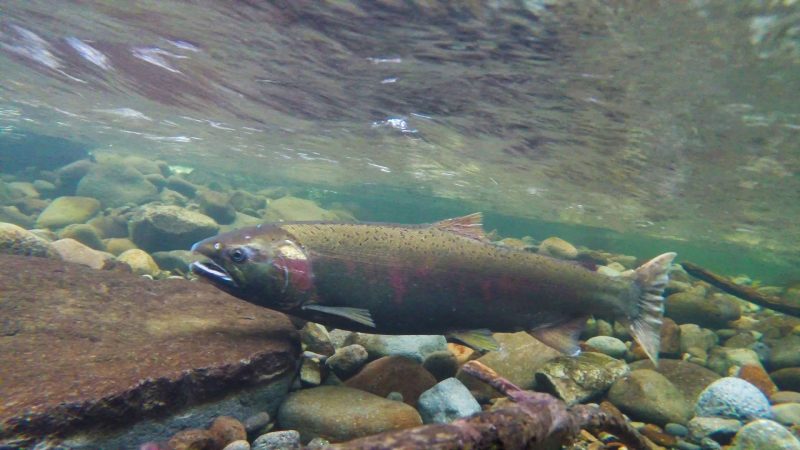
Researchers at the University of New Mexico in the United States recently reported in the journal Science Advances that active microbial communities have been found in the brains of wild and lab-raised members of the salmon family, including European rainbow trout, Chinook salmon, and Arctic char. In the brains of lab-raised rainbow trout, more than half of the bacteria may come from their blood and intestines, suggesting that microbes from other parts of the body can cross the blood-brain barrier and take up residence in the brain.
Previously, animal brains were thought to be sterile, with any bacterial invasion typically associated with disease. However, increasing evidence suggests that microbes invading the brain may be linked to diseases such as Alzheimer's in humans. This new discovery implies that bacteria in fish brains may not always be bad news. In most cases, despite the presence of microbes in the skulls of these fish, they appear to be healthy.
The researchers suggest that bacteria in the brain may help fish perceive microbial cues in their environment, aiding migratory fish in navigating river systems.
Bacterial testing was conducted on brain samples of rainbow trout, with blood being extracted from the animals first to prevent contamination. Analysis of genetic material from four brain regions indicated that bacterial levels in the rainbow trout brain were similar to those in the spleen but only one-thousandth of the levels found in the gut. Microbial communities were also found in the brains of wild rainbow trout, Atlantic salmon, Chinook salmon, and Arctic char, although these communities differed from those in lab-raised trout and may originate from different organs.
Study Reveals Active Microbial Communities in Fish Brains
Tags
A study published in Nature has uncovered a new mechanism for how the brain stores emotional memories—one that centers not on neurons, but on astrocytes, the star-shaped glial cells once…
When people experience striking events, not only do those moments become etched in memory, but even seemingly ordinary experiences that occurred shortly before can become unusually vivid. The neural mechanism…

People with attention-deficit/hyperactivity disorder (ADHD) may possess an often-overlooked strength: excessive curiosity. While typically associated with distractibility and hyperactivity, this trait is also closely linked to creativity, adaptability, and a…

Are colors perceived the same way by everyone? A new neuroscience study suggests that, at least on the neural level, the answer may be yes. The question of whether color perception…

For decades, neuroscientists believed that when a person loses a limb, the brain's corresponding sensory region would be “taken over” by neighboring body parts—a process known as cortical reorganization. However,…
Researchers from the University of California, Los Angeles, and Columbia University have discovered that neurons in the brainstem's locus coeruleus act like a “memory reset button”, segmenting continuous experiences into…