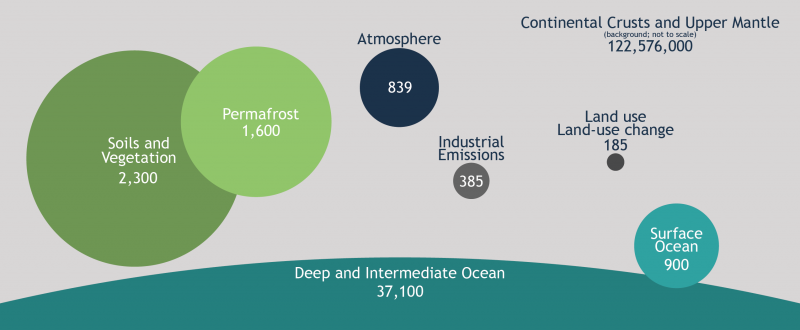
Scientists from Sweden and the US have conducted an assessment of greenhouse gas emissions in the Arctic, revealing that Arctic permafrost areas release more carbon into the atmosphere than they absorb. This finding contributes to further global warming. The study, published in the journal "Global Biochemical Cycles", sheds light on a long-standing uncertainty regarding whether permafrost regions act as net emitters of greenhouse gases. While the melting of permafrost releases carbon compounds from biological matter, an increase in plant growth has the potential to absorb more carbon dioxide from the atmosphere.
The research team, hailing from the Nordic Institute for Regional Research, discovered that permafrost areas have transitioned from being carbon sinks to becoming carbon sources. Between 2000 and 2020, the region emitted a staggering 144 million tons of carbon annually. Furthermore, the region also emitted methane and approximately 3 million tons of nitrogen per year, including nitrous oxide, a potent greenhouse gas.
Unlike previous studies that primarily relied on satellite data or machine learning techniques, this study took a ground-based approach. The team compiled emissions observations from 200 sites, extrapolating the data to areas with similar vegetation and humidity. Their findings suggest that permafrost regions represent a previously unaccounted source of atmospheric greenhouse gases in existing global climate models.
The research highlights the urgent need to consider the significant impact of Arctic permafrost emissions on global climate change. By uncovering this previously unaddressed source of greenhouse gases, scientists can refine climate models and improve our understanding of the complex dynamics driving climate change.
Arctic Permafrost Emissions Exceed Absorption, Amplifying Global Warming
Tags
The Sahara Desert, one of the driest places on Earth with an average annual rainfall of just about three inches, may experience a striking transformation later this century. A new study…

A new study led by the University of Exeter warns that the world has crossed its first recognized climate "tipping point", as coral reef ecosystems enter a state of widespread…

A new study led by the University of Reading challenges long-held assumptions about primate origins. For decades, scientists believed primates, including humans, emerged from warm, humid tropical forests. However, reanalysis…

A research team from The Hong Kong Polytechnic University has, for the first time, used Satellite Laser Ranging (SLR) technology to generate precise global records of ocean mass changes spanning…

Prochlorococcus, the most abundant microbe in the oceans, is facing a survival crisis due to global warming. This single-celled cyanobacterium, found across more than 75% of the ocean's surface waters,…
Climate change and plastic pollution are two of the most pressing environmental challenges facing humanity. A research team at the University of Copenhagen has developed a breakthrough material, BAETA, that…
