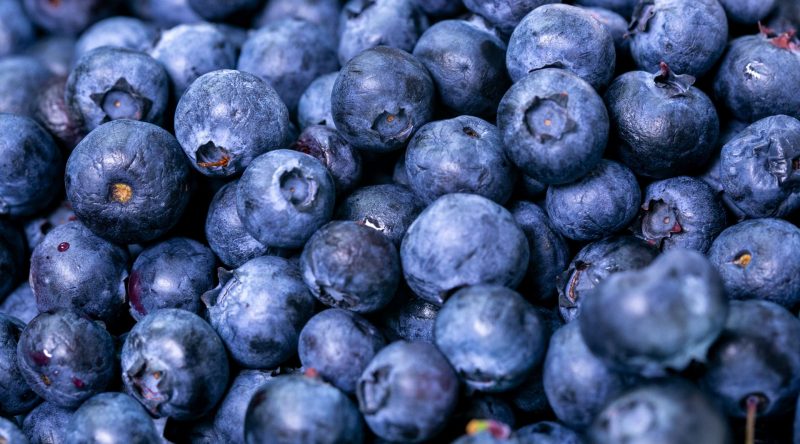
According to a recent article published in Science Advances on the 7th, researchers from the University of Bristol in the UK have made an interesting discovery about the blue color of blueberries and similar fruits. While the pigment in blueberry peels is actually dark red, the researchers found that tiny structures within the waxy layers of these fruits give them their blue appearance. This phenomenon is also observed in other fruits of the same color, such as plums, blackthorns, and juniper berries. The blue color is a result of the interaction between microscopic structures in the waxy layer and blue and ultraviolet light, which causes the fruits to appear blue to humans and bluish-ultraviolet to birds.
The researchers further explained that the blue color of blueberries cannot be extracted by squeezing them, as the color does not come from the juice. To investigate this further, they removed the waxy layer and recrystallized it onto a card, creating a new blue-ultraviolet paint. This ultra-thin colorant has a thickness of about 2 microns and, despite its low reflectivity, exhibits a distinct blue color and effectively reflects UV rays. This discovery holds potential for the development of a new coloring method.
While plants commonly have a thin waxy layer, scientists have only recently realized that this structure also plays a significant role in determining a plant's color. The waxy layer serves multiple functions, including acting as a hydrophobic and self-cleaning coating. Moving forward, the research team aims to find simpler ways to recreate and tint the coating, which could lead to the development of a more sustainable, biocompatible, and potentially even edible blue-ultraviolet reflective paint.
Tags
Are colors perceived the same way by everyone? A new neuroscience study suggests that, at least on the neural level, the answer may be yes. The question of whether color perception…
Over 10 million years ago, ancient African apes gained extra nutrition by eating fallen, fermented fruit—a behavior that may have laid the evolutionary foundation for humans' alcohol tolerance. A recent…
Researchers have successfully enabled five participants to perceive a completely new color—beyond the natural range of human vision—by selectively activating specific retinal cells using advanced laser and tracking technology. This…
Parrots are among the most colorful animals on Earth, yet scientists have struggled for decades to explain how their vibrant hues are formed. Now, a research team led by Charles…
MIT Study Reveals Brain's Efficient Object Recognition in Color and Black-and-White Images
A recent study conducted by MIT sheds light on the brain's remarkable ability to identify objects in both color and black-and-white images, despite the intricate processes involved in visual color…