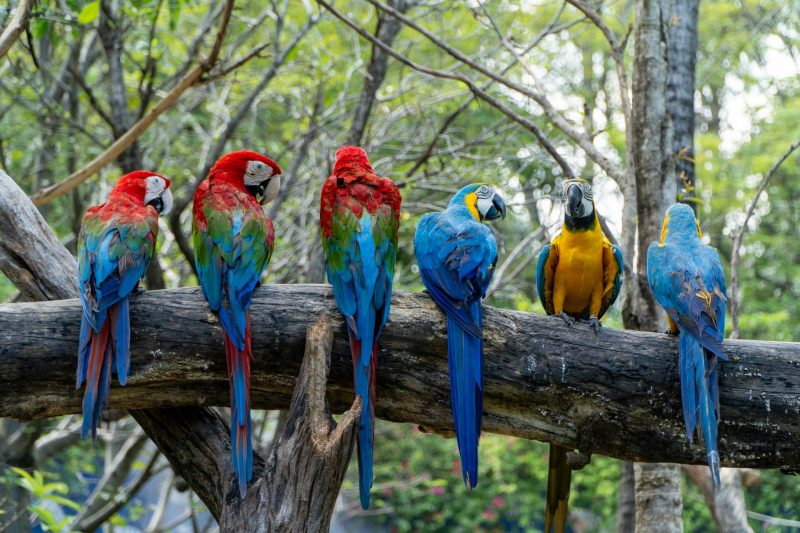
Parrots are among the most colorful animals on Earth, yet scientists have struggled for decades to explain how their vibrant hues are formed. Now, a research team led by Charles University in the Czech Republic has unveiled the unique biological mechanisms behind the bright red, yellow, and green colors of these birds. Through a detailed analysis of the developmental process of parrot feathers, researchers have discovered that a simple chemical modification — a parrot-specific pigment molecule — is key, a modification that may also be crucial in other realms of the animal kingdom. The findings of this study have been published in the latest issue of Science magazine.
Distinguishing parrots from other birds, they have the ability to produce a pigment called Psittacofulvins and adjust this pigment to create red and yellow colors. Scientists have known that Psittacofulvins are composed of carbon atom chains of different lengths. The research team found that the way this chain terminates determines the color produced by Psittacofulvins. For instance, when the chain ends in an aldehyde group, feathers appear red. However, if a carboxyl group replaces the aldehyde, feathers turn yellow. Researchers highlight that this is a remarkably simple chemical adjustment.
By studying a species known as the "black parrot", which displays yellow and red hues, the research group also identified a gene crucial for coloring in these birds and their close relatives. This gene encodes an enzyme that converts aldehydes to carboxyl groups, shifting the default red pigment to yellow. The more enzymes expressed by the gene, the yellower the feathers become.
Tags
A large-scale genetic study published in Nature Medicine has uncovered a surprising paradox: a gene mutation known to cause severe obesity appears to significantly reduce the risk of heart disease…

Humans can distinguish up to a trillion different odors—yet this remarkable ability relies on only about 400 types of olfactory receptor proteins. Because these receptors are notoriously difficult to express…

Global conservation groups, scientists and beekeepers are sharply divided over whether to ban the deliberate release of genetically engineered organisms into the wild. Dozens of NGOs have urged the International…

Single-Cell Sequencing Maps Plant Stem Cell Networks, Opening Path to Higher Crop Yields
Plant stem cells are the foundation of agriculture, underpinning the production of food, feed, and biofuels. Yet the core genetic networks controlling their activity have remained poorly understood. A research…

Are colors perceived the same way by everyone? A new neuroscience study suggests that, at least on the neural level, the answer may be yes. The question of whether color perception…

Although all vertebrates possess a pelvis, only humans have evolved a structure optimized for efficient, long-distance bipedal locomotion. This evolutionary transformation took over five million years, yet the precise developmental…