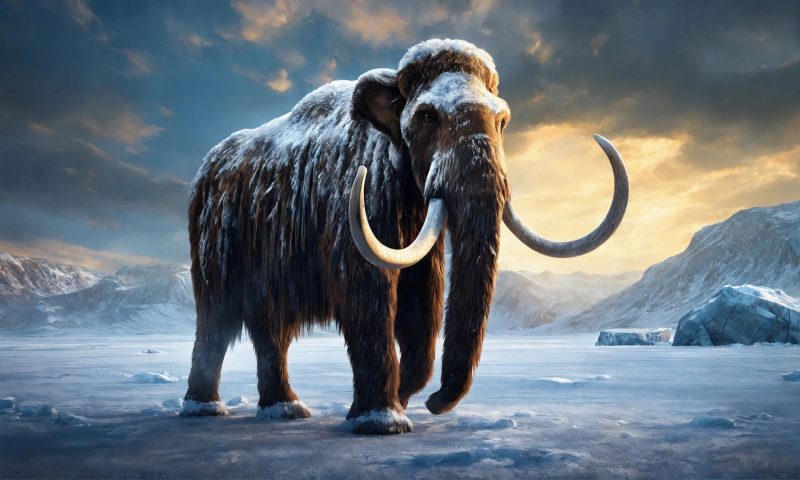
Around 50,000 years ago, a mammoth perished under mysterious circumstances in the Siberian tundra. This intriguing discovery was made recently. Researchers were astonished to find preserved chromosomes in their original three-dimensional (3D) structure within a skin sample, a feat previously believed to be unattainable in ancient DNA studies.
The team behind this breakthrough also unveiled the spatial organization of mammoth DNA molecules and active genes within the skin sample. One gene, in particular, was identified as responsible for the mammoth's distinctive hairy appearance. The findings of this study were recently published in the prestigious journal Cell.
Around four decades ago, scientists first realized that fragments of DNA could endure in ancient specimens, including Egyptian mummies dating back thousands of years. However, as time passes, DNA tends to degrade and suffer chemical damage, making it exceedingly challenging to reconstruct a genome in a 3D structure using these fragments. Until now, no one had attempted to investigate the organization of chromosomes in ancient cell nuclei due to the prevailing belief that the 3D structure of DNA would erode over time.
To challenge this long-held assumption, the researchers embarked on a nine-year quest to locate well-preserved ancient DNA samples. Eventually, they discovered nearly complete chromosomes within a skin sample from a woolly mammoth found in the Siberian permafrost. This particular mammoth had perished 52,000 years ago. The researchers meticulously examined the structure of mammoth chromosomes, shedding light on the folding patterns of DNA molecules and their spatial arrangement within the cell nucleus. These two characteristics play a vital role in determining which genes are activated and for how long.
Importantly, the methodology described in the research paper could also assist scientists in assembling a comprehensive mammoth genome. This development holds significance for Colossal Biosciences, a U.S. biotechnology company currently engaged in efforts to revive mammoths. The director of biological sciences at Colossal Biosciences expressed optimism regarding the potential of this approach in their endeavors.
Scientists Unearth Nearly Intact Mammoth Chromosomes for the First Time
Tags
A new study has revealed that the nematode Caenorhabditis elegans—a microscopic worm widely used in research—can pass longer lifespans to its offspring through epigenetic mechanisms, even when the descendants themselves…
Widespread Sex Reversal Found in Wild Birds Challenges Traditional Gender Identification
Many bird species display striking physical traits that distinguish males from females, such as the rooster's comb or the peacock's tail feathers. However, in species where the sexes look alike,…

For decades, scientists believed leprosy was a disease of the Old World, introduced to the Americas around 500 years ago by European colonizers and African slaves. The disease was traditionally…

A research team from the University of Minnesota Medical School has published a groundbreaking study in Nature Aging, shedding light on the relationship between stress and aging while delving into…

A preliminary analysis of DNA markers in over 3,000 individuals conducted by the University of Southern California suggests a potential link between exposure to extreme high temperatures and molecular changes…

In a recent paper published in Nature Communications, an international research team led by the University of Birmingham in the UK has uncovered the role of the protein USP50 in…