For nearly two centuries, scientists have attributed the slipperiness of ice to a thin lubricating layer formed by pressure or friction-induced melting. However, a new study from Saarland University in Germany challenges this long-standing explanation.
Using advanced computer simulations, researchers found that the key mechanism lies not in pressure or friction but in the molecular dipole interactions between ice and contacting surfaces such as shoe soles, tires, or skis. Ice molecules form an orderly crystal lattice at low temperatures, but when a dipole-bearing material touches the surface, the interaction disrupts this order, creating a disordered, amorphous layer that behaves like liquid.
Remarkably, this phenomenon persists even at extremely low temperatures. The study shows that an interfacial liquid film can still form close to absolute zero, though it becomes highly viscous—more like honey than water—rendering it unsuitable for practical sliding. This finding overturns the conventional belief that skiing is impossible below –40 °F, revealing that film formation still occurs but lacks the fluidity required for motion.
By overturning a 200-year-old assumption, the research not only reshapes our understanding of ice slipperiness but also offers new insights into interfacial physics and materials science.
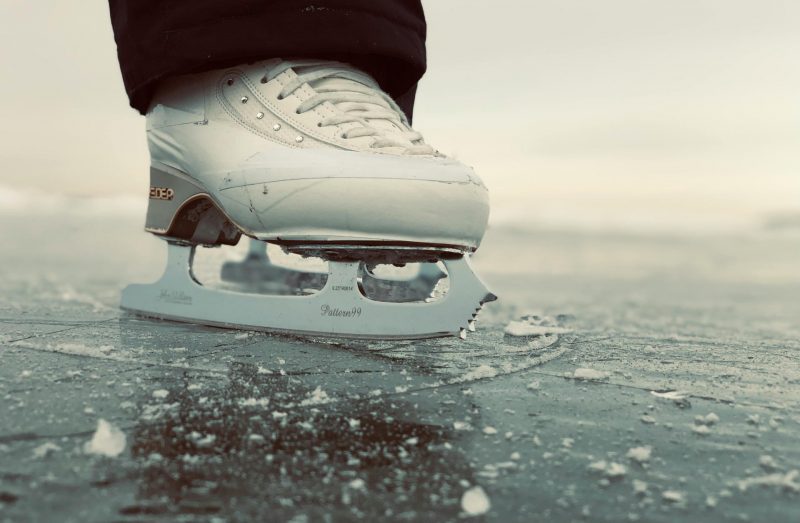
Image Credit: Efrem Efre
Tags
A groundbreaking study published in Nature Materials suggests that the combination of salt, ice, and mechanical strain could become a key to future renewable energy. Researchers have demonstrated that specially…
For decades, planetary scientists have believed that Jupiter's moon Europa may harbor potential habitats for extraterrestrial life. Beneath Europa's icy crust lies a vast salty ocean. However, researchers reported at…