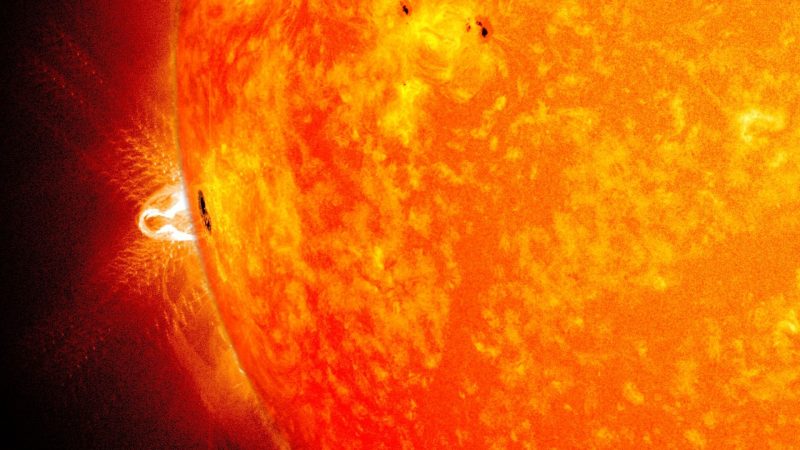
NASA recently reported that observations have revealed the existence of a "sunspot group" comprising at least six individual sunspot clusters. These "sunspot clusters" extend approximately 125,000 miles across the surface of the Sun, surpassing the width of Earth by more than 15 times. Additionally, over the past four days, the Sun has produced a total of 16 C-class and 3 M-class solar flares.
Astronomers have observed an ongoing process of fragmentation within these sunspot groups, resulting in the formation of new sunspots. Currently identified as AR3492, AR3495, AR3496, and AR3497, these sunspots collectively constitute a larger "sunspot group."
If these sunspots keep facing Earth as the Sun rotates, they have the potential to unleash additional energy, which could bombard our atmosphere with intense solar wind and energy. This, in turn, may lead to radio blackouts, GPS disruptions, and other forms of interference.
Scientists have issued warnings regarding the possibility of sunspot eruptions emitting violent energy towards Earth, potentially causing geomagnetic explosions. Such events pose a significant threat to our power grid, satellites, and could even result in devastating power outages.
Sunspots are dark areas that appear on the surface of the Sun due to intense magnetic activity. They are cooler and lower in temperature compared to the surrounding areas. Sunspots provide valuable insights into the Sun's behavior and magnetic fields. Scientists study them to understand solar activity and its effects on Earth.
NASA Observes Sunspot Groups and Solar Flares Pose Potential Threats
Tags
A groundbreaking study by scientists from Pennsylvania State University and Columbia University, recently published in Nature Geoscience, reveals that Earth's continents owe their long-term stability—and their role as the cradle…

For decades, scientists have been puzzled by a strange solar phenomenon often called “solar rain.” Unlike rainfall on Earth, this occurs in the Sun's corona—a superheated plasma layer above its…
Researchers at Carnegie Mellon University have developed “Zippy”, the world's smallest self-powered bipedal robot. Standing just 1.5 inches tall, Zippy can walk at over 0.5 miles per hour and is…

The University of Hong Kong (HKU) has surpassed Peking University (PKU) in the latest QS World University Rankings, becoming the highest-ranked Chinese institution and marking a significant achievement for the…

Over 80 exhibitors are showcasing more than 1,000 products — including Japanese sake, plum wine, and beer — at the ongoing Japan Sake Month, the largest Japanese sake trade fair…

Core Leak? Study Suggests Earth's Core Material May Be Reaching the Surface via Volcanoes
A groundbreaking study from the University of Göttingen challenges long-held assumptions about Earth's internal structure, suggesting that material from the planet's core may be leaking to the surface through volcanic…