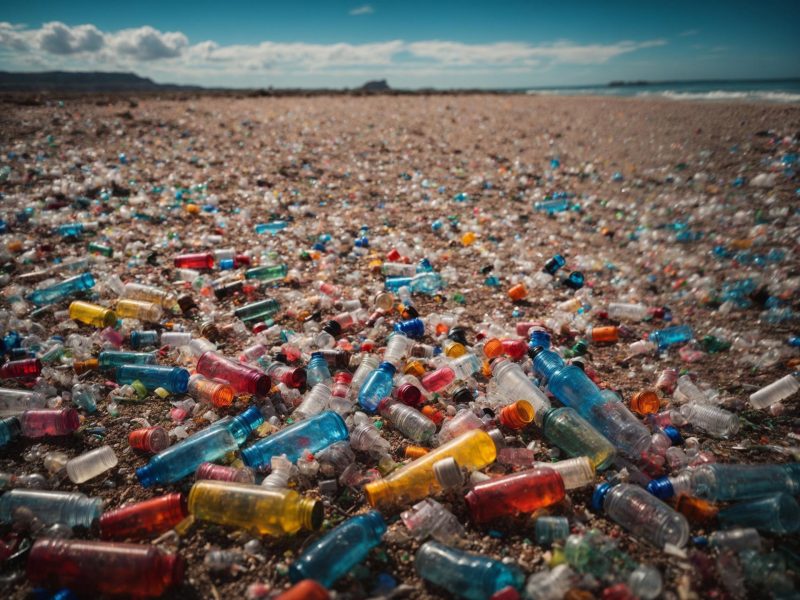
Differences in the recycling difficulty of various types and colors of plastics have been significantly noted. Recently, researchers from Cornell University and Princeton University in the United States published a study in the chemistry journal ACS Central Science, introducing a novel method to transform black and colored polystyrene waste into reusable materials using black plastic additives and sunlight or white LED light.
This emerging plastic recycling strategy involves photodegradation of plastics to produce chemically useful substances that can be recycled for manufacturing new products. The process requires an auxiliary compound to convert light energy into heat to break the polymer molecular bonds. The research team found that carbon black additives in black polystyrene waste can effectively serve this purpose. Carbon black not only works efficiently but can also be directly integrated into the recycled material, eliminating the generation of additional waste.
The researchers tested a recycling method for laboratory-manufactured black polystyrene: grinding polystyrene with carbon black into powder, placing it in a sealed glass bottle, and exposing it to intense white LED light for 30 minutes. Carbon black converts light energy into heat, causing the polystyrene to decompose into a mixture of mono-, di-, and tri-styrene units, which are then fully separated in the reaction vessel. In the experiment, the team successfully recycled the remaining carbon black and styrene monomers back into polystyrene, validating the method's cyclic sustainability.
Innovative Plastic Recycling: Converting Black and Colored Polystyrene Waste into Reusable Materials
Tags
Climate change and plastic pollution are two of the most pressing environmental challenges facing humanity. A research team at the University of Copenhagen has developed a breakthrough material, BAETA, that…

Earth's climate has swung dramatically between extremes of ice and heat throughout its history. In fact, for much of geological time, Earth has been a warm, ice-free planet. During the Cretaceous…

Researchers at Brunel University London have discovered that Pseudomonas aeruginosa, a common hospital pathogen, can degrade polycaprolactone (PCL), a biodegradable plastic widely used in medical devices such as sutures, implants,…
New Carbon Cloth Electrode Technology May Significantly Cut Costs in Seawater Desalination
A team of engineers from the University of Michigan and Rice University has developed a novel carbon cloth electrode that can effectively remove boron from seawater—potentially reducing the need for…

Plastic is ubiquitous in everyday life, and new research suggests that chewing gum may be an overlooked source of microplastic exposure. A preliminary study conducted by researchers at the University…

Korean Scientists Develop Radioactive Carbon Micro-Nuclear Battery with Enhanced Efficiency
Korean researchers are developing a micro-nuclear battery powered by radioactive carbon, which generates electricity through beta radiation-induced electron avalanche. This innovative technology is designed to be both environmentally friendly and…