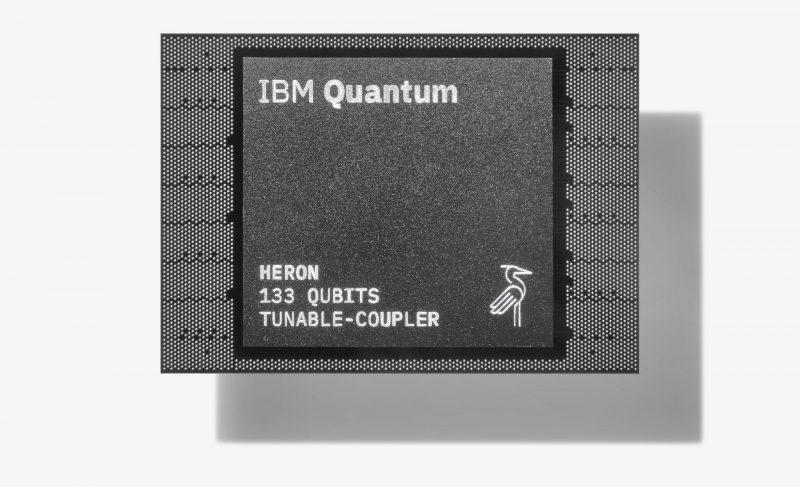
IBM, the renowned American technology giant, unveiled its latest quantum computing chip called “Heron” and a quantum computer at its annual quantum computing summit. The company expressed its vision of these advancements becoming the cornerstone of a larger-scale application system within the next decade.
“Quantum Heron” is touted as IBM’s most powerful quantum processor to date, boasting a 3-5 times reduction in error rate compared to its predecessor, the “Quantum Eagle” processor. IBM recently announced on social media that they will introduce a new error reduction method by connecting the chips within the machine and linking multiple machines together. This novel approach, combined with an innovative error correction technique, significantly enhances calculation accuracy.
Meanwhile, IBM unveiled the world’s first practical quantum computer system, “Quantum System 2”, designed to tackle complex problems beyond the capabilities of classical supercomputers. This modular system incorporates three “Quantum Heron” chips, each containing 133 qubits (qubits). The increased qubit count expands the quantum state representation space, enabling exploration of a broader range of computational possibilities.
By comparison, Google, another prominent technology giant, had previously released its Sycamore quantum processor with just over 70 qubits and a relatively higher error rate. IBM’s emphasis on qubit count demonstrates their ambitious goals. In June of this year, IBM made a breakthrough by achieving more accurate results at a scale of 100 qubits. Additionally, IBM published a paper in the journal Nature, revealing an “error mitigation” method that significantly reduces the error rate in quantum computing. Dario Gil, IBM’s senior vice president and research director, highlighted the stability of technological progress until 2029, when error correction technology is expected to play a comprehensive role. IBM’s stringent requirements for accuracy and efficiency have accelerated the implementation of their quantum chips.
Currently, users can access “Quantum Heron” through IBM’s cloud platform. Furthermore, IBM announced plans to introduce more “Quantum Heron” processors to the market in the coming year.
Quantum computers, leveraging the principles of quantum mechanics such as quantum superposition and entanglement, offer a new computing paradigm compared to traditional computers that rely on transistors for logic gates and data storage. Theoretically, quantum computers possess immense computational power, surpassing traditional computers in specific domains such as prime factorization and quantum simulation.
The commercialization of quantum computing is steadily becoming a reality. Dario Gil, referring to IBM’s latest chip, stated, “The line between quantum research and commercialization is blurring, although it will take some time to transition from scientific value to commercial value.” Many laboratories and universities worldwide have already begun utilizing IBM’s new systems to conduct cutting-edge quantum computing research. Institutions such as the U.S. Department of Energy’s Argonne National Laboratory, the University of Tokyo, and the University of California, Berkeley, are leveraging quantum computing to explore complex problems in quantum physics, chemistry, materials, and other fields. Quantum computing is rapidly emerging as a practical tool within the scientific community.
In view of the growing demand for generative AI and large-scale models, the need for unprecedented computing power continues to rise. The capabilities of quantum computers may witness significant advancements in the future. Similar to the sudden transformative changes experienced by AI and machine learning in recent years after a gradual development period, the era of quantum computing power may be closer than we think.
IBM Launches Modular Quantum Computer System for Large-Scale Applications
Tags
Researchers at Carnegie Mellon University have developed “Zippy”, the world's smallest self-powered bipedal robot. Standing just 1.5 inches tall, Zippy can walk at over 0.5 miles per hour and is…

The University of Hong Kong (HKU) has surpassed Peking University (PKU) in the latest QS World University Rankings, becoming the highest-ranked Chinese institution and marking a significant achievement for the…

Over 80 exhibitors are showcasing more than 1,000 products — including Japanese sake, plum wine, and beer — at the ongoing Japan Sake Month, the largest Japanese sake trade fair…

Subatomic particles such as quarks can be linked by "strings" of force fields that release energy when stretched to the point of breaking. Recently, two international research teams successfully simulated…

China will expand its visa waiver policy to include six additional countries starting June 1, aiming to further stimulate inbound tourism. Under a reciprocal agreement with Uzbekistan, citizens of both countries…

SpaceX Cleared to Boost Starship Launch Frequency in Texas, Expands Nationwide Launch Ambitions
SpaceX has received regulatory approval to significantly increase the launch frequency of its Starship rocket from its Texas launch site, marking a key milestone in the company's strategy to scale…