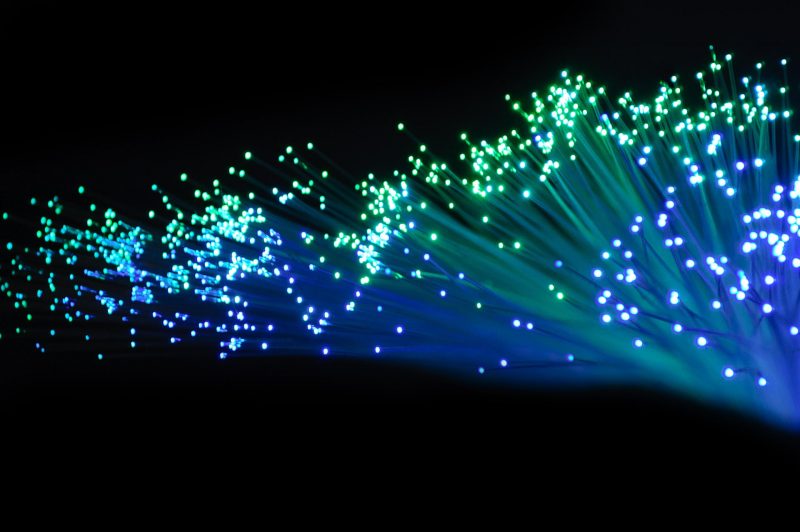
A new type of hollow-core optical fiber could dramatically enhance both data capacity and transmission distance in a single strand, paving the way for faster and more efficient telecommunications networks. Developed by researchers at the University of Southampton, the technology was published on September 1 in Nature Photonics.
Unlike conventional solid-glass fibers, the new design features a distinctive “glass straw” structure. Its core is formed by a ring of five microscopic glass tubes, each nested with two even finer tubes. These precisely engineered channels allow only specific wavelengths of light to travel through the hollow interior, effectively confining light within the core and minimizing signal loss.
The hollow architecture enables light to travel about 45% faster than in standard fibers, making it especially valuable for latency-sensitive applications such as data center interconnects. It also achieves substantially lower signal loss—retaining half its strength even after 33 kilometers, compared with just 15–20 kilometers in commercial fibers. This extended reach allows relay stations to be placed farther apart, reducing infrastructure costs.
Beyond lower loss, the fiber can carry up to a thousand times more power and support a broader wavelength range, including visible light, making it suitable for quantum communication systems. By contrast, traditional fibers are optimized mainly for infrared wavelengths around 1.5 micrometers.
Although hollow-core fibers have historically faced cost barriers, the researchers note that scalable production could significantly reduce prices. The breakthrough is seen as a potential game-changer for both classical internet infrastructure and future quantum communication networks.
Hollow-Core Fiber Breakthrough Promises Faster, Longer-Distance Data Transmission
Tags
Breakthrough in Optical Control of Ferroaxial Materials Paves Way for Next-Generation Data Storage
In today's digital world, information storage relies on binary code, where any physical system with two stable states can serve as a data carrier. Ferroic materials—such as ferromagnetic and ferroelectric…

Why do bats frequently collide with wind turbines? A new scientific study points to visual misperception as a key factor. While the impact of turbines on birds has long been…

A new study published in Science reveals that artificial night lighting significantly prolongs daily birdsong, marking the first global-scale validation of this phenomenon. Researchers from Oklahoma State University and Southern Illinois…

A new study reveals that Earth's civil and military radar systems may be inadvertently transmitting signals into space that could be detected by alien civilizations. These unintended electromagnetic emissions—especially from…
New Molecular Magnet Sets Record for High-Density Data Storage at Elevated Cryogenic Temperatures
A research team from the University of Manchester and the Australian National University has developed a novel molecular magnet capable of storing data at the ultra-low temperature of 100 Kelvin…