Scientists have long puzzled over how fruit fly sperm—stretching up to 1.8 millimeters, nearly the length of the adult body—avoid becoming hopelessly entangled inside storage organs just 200 micrometers wide. A new study combining mathematical modeling with fluorescence microscopy has now uncovered the biophysical mechanism behind this collective coordination.
The research shows that fruit fly sperm exhibit distinctive group dynamics in confined environments. While a single sperm cell can only twitch in place and is poor at swimming freely, densely packed sperm exploit their neighbors as “propulsive pivots,” particularly those moving in opposite directions, to generate forward motion. Researchers liken this system to “a multi-lane highway with lanes constantly rearranging,” where continuous local interactions guide the entire group into directional flow.
Crucially, this collective propulsion prevents entanglement. The sperm flagella remain stretched and aligned in parallel, reducing the risk of knots that would otherwise block transfer during mating and cause infertility. The findings challenge the traditional view that reproductive success hinges on competition among the strongest sperm, instead highlighting cooperation as the key to effective delivery.
Published on the preprint platform arXiv, the study not only resolves a central question in fruit fly reproductive biology but also offers a new paradigm for understanding how densely packed cell populations coordinate movement. The insights may inform research in ecology, swarm robotics, and other fields exploring self-propelled systems under crowded conditions.
Fruit Fly Sperm Reveal Collective Motion That Prevents Entanglement
Published on Sep 8, 2025
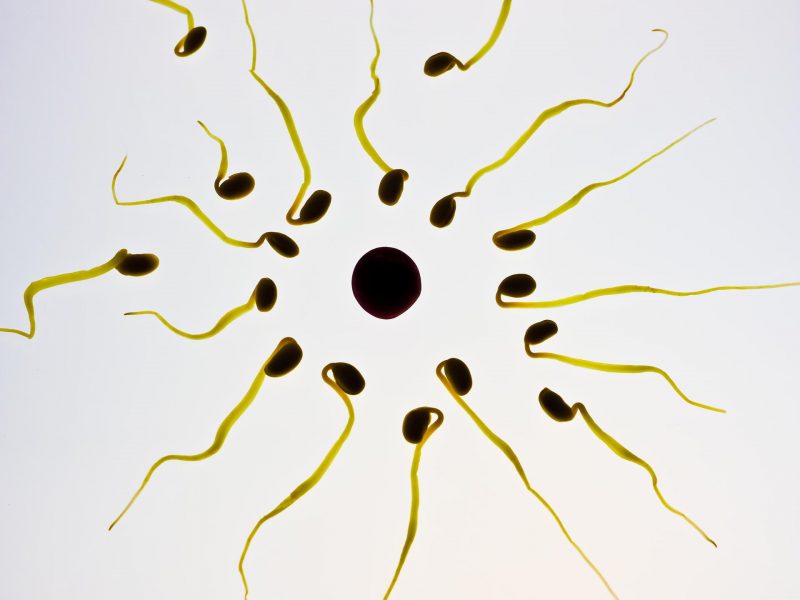
Image Credit: Thomas Breher
Tags
The research team supported by the National Institutes of Health (NIH) has unveiled, for the first time, a comprehensive map of neural connections in the common fruit fly brain. This…