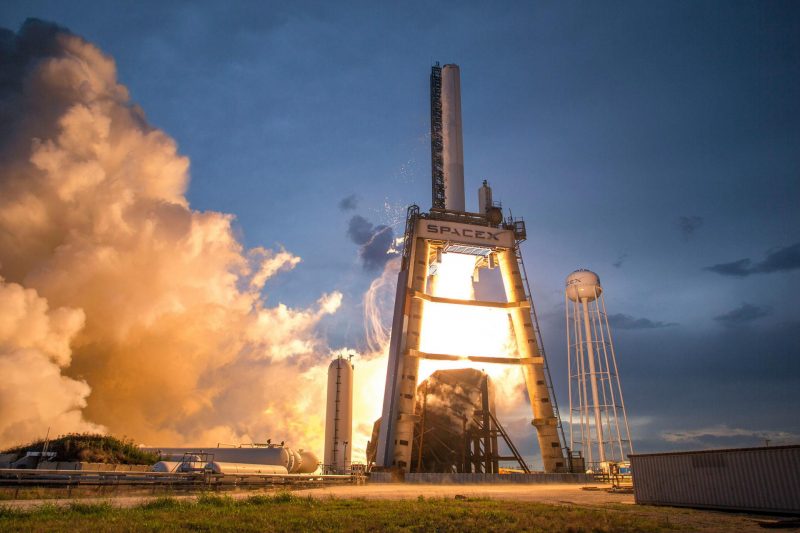
Foxconn, the world's largest manufacturer of iPhones, has ventured into a new field by launching two satellites into low-Earth orbit. The satellites were successfully deployed aboard a SpaceX rocket from Vandenberg Space Force Base in Southern California last Saturday.
This development represents a significant milestone for Foxconn as it seeks to expand its business beyond smartphones and laptops, which have been facing challenges in the market. The company aims to capitalize on the growing demand for space communication by showcasing its satellite technology.
While SpaceX, led by Elon Musk, has already launched over 5,000 low-Earth orbit satellites for its Starlink project, Foxconn is primarily focusing on manufacturing satellites for corporate and government clients.
The two satellites were jointly developed by Foxconn and Taiwanese universities. They are compact, weighing approximately 9 kilograms each, and are equipped with cameras, communication devices, and other necessary equipment. They are designed to orbit the Earth at an altitude of 520 kilometers, completing one revolution every 96 minutes.
Since assuming the role of chairman in 2019, Young Liu has actively sought avenues to diversify Foxconn's business. The company has been expanding into various sectors, including electric vehicles, digital health, robotics, artificial intelligence, semiconductors, and most recently, communication satellite technology. In an interview, Liu emphasized the importance of finding opportunities that will sustain the company's growth for the next decade or so. He stated in the interview that he needs to find something that will keep the company growing for the next 10 to 15 years.
Foxconn, currently ranked as the world's third-largest private employer, following Walmart Inc. and Amazon.com Inc., is projected to experience a decline in revenue of approximately 6% this year, amounting to NT$6.2 trillion (US$192 billion).
Tim Farrar, president of Telecom, Media, and Finance Associates Inc., a consultancy firm, noted that unlike Apple's predictable demand for millions of iPhones each quarter with frequent model updates, the satellite business may face challenges due to less frequent orders at longer intervals. Farrar mentioned that for an outsourced manufacturer like Foxconn, it can be tough unless they can find another business at the right time.
Given this context, Farrar suggested that government contracts could provide a level of stability for Foxconn's satellite business. He stated that Foxconn is thinking that if the authorities give them a certain number of orders every year, then they're fine.
Another area where Foxconn receives support is its electric vehicle venture, as these vehicles rely on real-time communication technology. Jason Wang, a Foxconn analyst at MasterLink Securities Corp., emphasized the need for infrastructure development in Taiwan to showcase their solutions for electric vehicles. He mentioned that to enter this business, Foxconn must establish an infrastructure in Taiwan to demonstrate their solutions for electric vehicles.
Foxconn's expertise in electronics manufacturing, gained from producing smartphones, gaming consoles, and other devices, positions the company well for this undertaking. An industry insider remarked that Taiwan's strong track record in manufacturing various commercial electronics products positions it well for a seamless transition into the space sector.
Foxconn Launches Satellites as it Diversifies Beyond Smartphones
Tags
Researchers at Carnegie Mellon University have developed “Zippy”, the world's smallest self-powered bipedal robot. Standing just 1.5 inches tall, Zippy can walk at over 0.5 miles per hour and is…
The University of Hong Kong (HKU) has surpassed Peking University (PKU) in the latest QS World University Rankings, becoming the highest-ranked Chinese institution and marking a significant achievement for the…

Over 80 exhibitors are showcasing more than 1,000 products — including Japanese sake, plum wine, and beer — at the ongoing Japan Sake Month, the largest Japanese sake trade fair…

China will expand its visa waiver policy to include six additional countries starting June 1, aiming to further stimulate inbound tourism. Under a reciprocal agreement with Uzbekistan, citizens of both countries…
Mountains are among the most biodiverse ecosystems on Earth, yet global environmental changes are profoundly reshaping them. Over the past 50 years, rising temperatures and shifts in land use have…

SpaceX Cleared to Boost Starship Launch Frequency in Texas, Expands Nationwide Launch Ambitions
SpaceX has received regulatory approval to significantly increase the launch frequency of its Starship rocket from its Texas launch site, marking a key milestone in the company's strategy to scale…